politics
Political figures, histories, and current events in the whole scope of modern and past politics. Work place politics.
Fifth week of US and Israeli attacks on Iran: Tensions rise further
(Writing and analysis: Journalist Malik Sarfaraz Hossein Awan) The fifth week of the ongoing US and Israeli military operation against Iran has ended today. The US Central Command (CENTCOM) today released video of airstrikes targeting drones, tanks and missile launchers in Iran. These attacks resulted in massive explosions in the central Iranian city of Isfahan, where thick smoke was seen rising. In addition, attacks were also carried out near the international airport in the city of Mashhad. US President Donald Trump, addressing the nation, said that the US is close to achieving its strategic goals against Iran. He announced that severe attacks on Iran will continue in the next two to three weeks and said, "We will send them back to the Stone Age where they belong." Trump also said that countries shipping oil through the Strait of Hormuz needed to show courage. The Iranian military responded quickly, threatening "devastating, widespread and more severe" attacks. Immediately after Trump's speech, Iran fired a large number of missiles towards Israel. Explosions were heard in Tel Aviv and other areas. Israeli air defense systems intercepted most of the missiles, but missile debris injured at least 5 to 14 people near Tel Aviv. It was the largest missile barrage from Iran on Israel in recent weeks. Iran also launched missile attacks on Gulf countries. Bahrain, the United Arab Emirates and Saudi Arabia disabled several missiles. A fire broke out at an airport in Kuwait, which was extinguished. Iranian officials said their military capabilities were still there and they would take "more devastating" actions in response. According to confirmed figures so far, at least 2,076 people have been killed and 26,500 injured in the US and Israeli attacks in Iran. Iran has rejected any request for a ceasefire and said that the fighting will continue until the US and Israel withdraw. Analysis: Situation Overview and Possible Outcomes Today’s developments once again bring the complexity of the entire conflict to the fore in a bloody reality. Imagine smoke rising in the streets of Isfahan, people fleeing their homes, and sirens blaring at Mashhad airport. US President Trump’s address is not only a declaration of military confidence, but also a message that demonstrates his determination to completely weaken Iran. But the Iranian military’s swift and powerful response suggests that this war is far from over. Iran’s missile attacks on Israel and the Gulf countries are an example of a lively response that shows that despite technological superiority, subduing regional powers is not as easy as it seems. This situation is igniting a dangerous fire for regional stability. While the US and Israel claim to have achieved their strategic goals, the threats of further attacks on Israel by Iran’s proxy forces, especially the Houthis in Yemen, are dragging the entire Middle East into a wider circle. Oil prices are skyrocketing, the shadows of a recession are deepening in global markets, and millions of families are being affected. The pain of human losses is not just in the numbers, but in the cries of every injured child, the tears in the eyes of every martyred mother. Behind the 2,076 deaths and 26,500 injuries, there are thousands of stories that can never be told. Military experts say that if this fighting continues for two to three weeks, the pressure on Iran’s economy will be unbearable. The threat of a closure of the Strait of Hormuz could affect global oil supplies, which could shake the economies of Europe, Asia, and the United States. China and Russia are still silent, but if this conflict escalates, they could also come to the fore, which could change the balance of global powers. Iran’s military capability is not yet completely exhausted. It still has missiles, drones, and underground facilities that give it the power to fight a long war. On the other hand, the American and Israeli leaderships are also facing internal pressure. The American public is feeling war fatigue, while the barrage of missiles in urban areas in Israel is spreading fear. This war is not only military but also psychological and economic. If a diplomatic solution is not found immediately, this regional crisis could turn into a world war. This situation teaches us a harsh lesson that when the use of force is excessive, its consequences are always disastrous. The Iranian nation still has the courage to resist, while the United States and Israel will also have to take care of their own goals as well as human lives. The international community must intervene immediately. The United Nations, the European Union, and the Arab League must work together to develop a peace plan to prevent further bloodshed. The situation is changing rapidly. New news is coming in every hour. If this fighting continues, it will change not only the geopolitics of the Middle East but the entire world. Restoring peace now requires not just words, but urgent action.
By Malik Sarfraz Hussain Awanabout 4 hours ago in Journal
Today's big sensation in the Iran-Israel-US war: Trump's ceasefire claim, Iran laughs and rejects
(Writing and analysis: Journalist Malik Sarfaraz Hussain Awan – Social Guardian / Humanitarian) According to verified sources Al Jazeera, New York Times, CNN, Reuters, AP and other reputable international news agencies, today, April 1, 2026, the Iran-Israel-US war has entered its fifth week and military operations remain intense, while contradictions in statements and a standstill in diplomatic efforts have further complicated the situation. This evening, Iran launched a large-scale missile attack on central Israel, including Tel Aviv and Bnei Brak, in which about 10 ballistic missiles were fired. Several places, including a coffee shop, were hit and at least 14 people were injured in the attack, including an 11-year-old girl. The Iranian Revolutionary Guards have The Houthis claimed additional missile attacks on Israel in coordination with Iran and Hezbollah. On the other hand, Israel carried out more than 400 airstrikes on several cities in Iran, including Tehran, targeting weapons production sites, ballistic missile factories and infrastructure. The United States also intensified attacks on Iran's nuclear facilities and steel mills and used B-52 bombers, while more than 50 people, including a Hezbollah commander, were killed in Israeli attacks in Lebanon. Speaking of statements, US President Donald Trump claimed on Truth Social today that Iran's new regime president has requested a ceasefire from the United States and he made it clear that a ceasefire will not be considered until the Strait of Hormuz is open, free and clear, but Iran will be pushed back to the Stone Age. Trump also said that the United States will withdraw from the Iran operation in two to three weeks and will make an important address to the nation tonight, while he called NATO a paper. Iranian officials openly ridiculed Trump's claim, and the Foreign Minister and other officials called it false and baseless, making it clear that Iran is not asking for a ceasefire, but rather a complete end to the war, which includes guarantees to prevent recurrence of aggression, compensation, and Iranian sovereignty over the Strait of Hormuz. Iranian officials said that Iran is fully prepared to continue fighting until the threat of future aggression is eliminated. The diplomatic efforts are currently stalled. The United States had presented a 15-point plan through Pakistan, which includes sanctions on Iran's nuclear program, missile limits, and opening the Strait of Hormuz, while Iran gave a 5-point counterproposal. China and Pakistan have presented a joint 5-point peace plan, but due to lack of trust between the two sides, no concrete progress has been made. Iran has welcomed Russia as a mediator, but direct talks with the United States and Israel are not taking place. Trump has said that the war can be ended even without a deal. It can be done, but Iran has rejected it. The chances of ending the war currently seem limited because military attacks are ongoing, there is confusion at the diplomatic level, and the global economy is being severely affected by oil prices and the supply chain. A deeper analysis of today's situation is that it is clear from the contradictions in military intensity and statements that the war is still in its acute phase. The United States intends to withdraw in two to three weeks, but due to Iran's strong resistance, the condition of guarantees, and the actions of regional allies, the chances of ending it are less than 50 percent. Both sides are busy trying to weaken each other, but due to global pressure, economic damage, and threats to oil supplies, the path to negotiations may have to be kept open. Otherwise, this long war will further increase regional instability. And the diplomatic efforts of countries like Pakistan are playing an important role. But for success, it is necessary to restore trust between the parties, which does not exist at present. Therefore, today has been a mirror of the contradictions in military intensity statements and diplomatic confusion. If the talks on guarantees move forward in the future, the situation may change in two to three weeks, otherwise the disaster may spread further. This comprehensive report and analysis is based only on today's verified sources and does not include any speculation or rumors.
By Malik Sarfraz Hussain Awana day ago in Journal
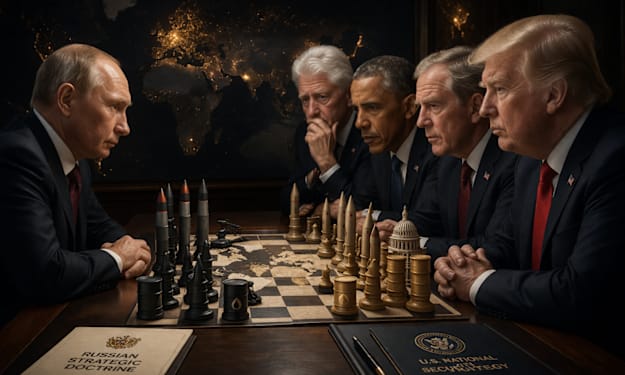
GEOPOLITICAL CHESS: HOW VLADIMIR PUTIN DRAGGED THE WEST INTO A ‘NO-CHOICE GAME’ (An Independent Expert Perspective)
In the 21st century, we are witnessing a paradigm shift in global governance: the transition from a "politicians' game" to a "Grandmasters' arena." Traditional diplomatic summits, official notes, and UN speeches are losing their relevance. The unipolar world order is eroding, and the era of classical politics is coming to an end. The core reality is this: since Vladimir Putin’s ascent in the early 2000s, traditional governance has been replaced by "Intelligence-ocracy" (Razvedkakraiya)—a new world order built on the algorithms of specialized services, now reaching its strategic zenith.
By Бахромжон Сувановa day ago in Journal
A War beyond borders: Iran vs America and the future of the global economy
The world is at a point where a war is no longer limited to just two countries... but is slowly engulfing the entire global economy. The growing tension between iran and the united states is not only creating political risks but is also affecting global oil prices, businesses, and the food and livelihoods of the poor.
By zulqarnain3 days ago in Journal
India is preparing to embroil Pakistan in a potential conflict on its borders,
India is preparing to embroil Pakistan in a potential conflict on its borders, According to defense and diplomatic experts, relations between India and Israel have been strengthening for the past several years
By Malik Sarfraz Hussain Awan3 days ago in Journal
Day 31 of the Iran War: Gulf in Blood, Houthis Open New Front
Analysis Malik Sarfaraz Hussain Awan, March 30, 2026: Friends, analysts and international media viewers, today the situation in the Middle East has reached a very dangerous point and it is no longer just a war between Iran and Israel, but the entire Gulf, the Red Sea and the global energy supply lines have become entangled together, where the 31st day of "Operation Roaring Line" has witnessed intense operations on multiple fronts, and Iran directly targeted the Gulf countries with missiles and drones on a military camp in Kuwait, in which 10 Kuwaiti soldiers were injured, while the Emirates Global Aluminum Plant in the United Arab Emirates and the Al-Baha Factory in Bahrain were also attacked, which the Arab League has strongly condemned and Iran has given a clear message that whoever supports the United States and Israel will also be targeted. Meanwhile, the Houthis in Yemen have fired ballistic missiles and drones at southern Israel, blaring sirens as far as Haifa Port, and have announced that their operations will continue until the attacks on Iran and the axis of resistance stop. Which is a new serious threat to the Red Sea and the Bab al-Mandab, while on the other hand, the IDF has carried out more than 140 attacks on Iranian missile and drone production sites, including Tehran, and US forces have targeted Iranian command centers, as well as deployed 3,500 additional Marines to the region through the Pentagon, and planning is underway for a possible operation on Iran's main oil export hub, Kharkiv Island. Regarding important statements and contradictions, President Trump made the explosive claim on Air Force One that regime change has occurred in Iran, the leaders have disappeared, and the military has been weakened, and warned that if a deal is not made, Iran's energy facilities and oil wells will be completely destroyed. While the Iranian Foreign Ministry has described this US offer as unrealistic and excessive, it has vowed to respond with full force against a ground attack. And although Saudi Arabia, the UAE, Qatar, and Bahrain have condemned Iran's attacks, they are privately worried about the economic losses of the war because this war is now limited to limited attacks. It has escalated into a full-scale regional conflict and the entry of the Houthis is seriously threatening Red Sea shipping, and the biggest game changer is the arrival of thousands of US Marines and the possible occupation of Kharkiv Island, which will severely affect global oil supplies and lead to an energy crisis in Europe and Asia. So the biggest question now is whether there will be a ceasefire by the April 6 deadline or a ground operation on Kharkiv Island will start and set the entire region on fire. And my final thought is that the continuation of this war is now changing the geopolitical map of the region. If there is no ceasefire by the April 6 deadline, a possible US operation on Kharkiv Island will not only paralyze Iran’s economy but could also cause a 20-25% reduction in global oil supplies. China, which is Iran’s largest oil buyer, cannot tolerate this situation and is increasing diplomatic pressure through the Shanghai Cooperation Organization, together with Russia. Pakistan, a long-standing ally of the Gulf states on one hand and a direct neighbor of Iran on the other, is now in a most delicate position. Islamabad’s policy of neutrality is commendable, but if the war spreads further, Pakistan’s oil imports, remittances, CPEC projects and border security will all be at risk. Should Pakistan now play an active diplomatic role? Can regional countries make Pakistan a platform for mediation? These questions are a major test not only for Pakistani foreign policy but also for the entire Islamic world. If today’s silence becomes tomorrow’s big price, history will not forgive us.
By Malik Sarfraz Hussain Awan3 days ago in Journal
The world on the brink of crisis: American leadership, three war fronts and the dark shadow of global catastrophe
Special Report by Malik Sarfaraz Hussain Awan: The world's only superpower, the United States, re-elected Donald Trump as president in the 2024 elections, and Trump's second term, starting in January 2025, is causing severe conflicts and economic pressure on the global level under the "America First" policy. At the end of February 2026, joint air operations by the United States and Israel began direct attacks on Iran, which has plunged the Middle East into the flames of full-scale war, and despite the passage of a month, this war continues, resulting in the death of thousands of innocent people and the global economy suffering the most severe setbacks, while President Trump's unilateral cancellation of the Iran nuclear deal in his first term, the closure of the US embassy, The transfer of Jerusalem and the policy of complete and blind support by Israel have actually formed the basis of today's horrific crisis that has fueled instability in the Middle East, and Trump's trade war with China, distrust of NATO allies, and the selfish strategy of "America First" have badly affected the balance of global power, resulting in new and escalating conflicts. The world is currently fighting on three major fronts simultaneously. On the first front, Russia's invasion of Ukraine since 2022 is still in its fourth year. In March 2026, Russian forces launched a regular spring and summer offensive, in which, according to Ukrainian Commander-in-Chief General Oleksandr Syrsky, an average of hundreds of attacks were carried out in 24 hours between March 17 and 20 alone, and thousands of soldiers were killed and injured. Although Ukraine has also taken some counterattacks and drone strikes on Russian oil facilities have But the continuous supply of weapons by the US and Western allies is prolonging this war and completely paralyzing the European economy and supply chain. On the other major front, on February 28, 2026, the US and Israel launched large-scale air strikes on Iran under 'Operation Epic Fury' and 'Roaring Line', targeting Iran's nuclear and missile infrastructure, killing several high-ranking officials. In response, Iran fired retaliatory missiles at Israel and US bases, including Gulf countries, which has now spread to Lebanon and seriously jeopardized the security of peaceful and economically stable Gulf states like Saudi Arabia, Kuwait and the United Arab Emirates. Similarly, as a third major maritime crisis, the Iranian-backed Houthi rebels have threatened to attack ships in the Red Sea, and the closure of the Strait of Hormuz has affected a large part of global trade, forcing shipping companies to take longer routes. This crisis has destroyed the global supply chain and caused Brent crude oil prices to plummet. Crude oil prices have risen from $105 to $118 per barrel in March 2026, which is causing a devastating storm of inflation in poor and developing countries. The International Monetary Fund (IMF) has also warned that if these wars continue, global economic growth will be severely affected and developing countries, including Pakistan, will suffer from severe starvation and poverty. Therefore, according to impartial analysts, the current US leadership does not seem to have a clear strategy to get out of these crises and the decisions seem to be based on temporary reactions and panic. If the major powers do not immediately set the table for negotiations, the threat of a third world war could be very real. And since history is witness that when leaderships fail, public protests always become a source of major change, it is time for the American people to stop waiting for the next elections in 2028 for the sake of their country's declining global reputation and the survival of humanity, and to act today. Let's take to the streets and start a peaceful but vigorous protest movement because if they continue to remain silent spectators, future generations will never forgive their silence. Finally, the international community, especially Pakistan, and all developing countries should learn a hard lesson from this crisis that the weak always bear the brunt of the selfishness of global powers. Therefore, there is an urgent and urgent need to restore peace, make vigorous diplomatic efforts, and make balanced policies to save the world so that humanity can be prevented from falling into the pit of this horrific disaster.
By Malik Sarfraz Hussain Awan3 days ago in Journal
The flames of war flared up in the Middle East: Trump’s adventures and Gulf contradictions have brought the world to a dangerous turning point
(Special Report: Journalist Malik Sarfaraz Hussain Awan) The Middle East is currently sitting on the worst and most dangerous gunpowder pile in history, where even a small spark can turn the peace and economy of the entire world into a pile of ashes. Donald Trump’s unpredictable foreign policy and American adventures in the Gulf region have so badly disturbed the traditional balance of the region that the flames of war are now crossing the borders and reaching the safest havens of the Gulf countries. The dramatic military and diplomatic developments in recent hours are clear evidence that this crisis is no longer just a regional conflict, but has emerged as a deadly poison for the global economy and security. The biggest and most horrific news has come from the United Arab Emirates, where the UAE Ministry of Defense has officially confirmed that its advanced air defense system destroyed 16 ballistic missiles and 42 drones launched by Iran in the air. Iran has mainly targeted industrial and military areas in Abu Dhabi and Dubai. Although the air defense prevented a major disaster by thwarting this major attack, debris and direct attacks have still caused heavy explosions in densely populated areas of Dubai and industrial zones in Abu Dhabi. Iran has specifically targeted the aluminum industry, damaging the Emirates Global Aluminum plant in Abu Dhabi and injuring employees working there. According to the Ministry of Defense, so far, two UAE military personnel, a Moroccan contractor working for the military, and eight civilians from Pakistan, Nepal, Bangladesh, Palestine, and India have been killed in these attacks, while a total of 178 people from different countries have been injured. The decision of Yemen’s Houthi rebels to enter regular war has added fuel to the fire. Houthi spokesman Yahya Saree confirmed in his official statement that they have fired drones, including ballistic and cruise missiles, targeting Israel’s southern and sensitive military sites. This move by the Houthis will expand the scope of this war to the strategic routes of the Red Sea and Bab al-Mandab. About 12 percent of the world’s trade passes through these sea routes. If the Houthis start targeting global shipping like in the past, the international energy market and supply chain will be completely paralyzed, resulting in exorbitant inflation and economic collapse on a global scale. If we look behind the scenes of all these serious military adventures, the biggest root is the open contradiction and double standards of the US Gulf policy. On the one hand, the US sings the tune of peace and security in the Middle East, and on the other hand, it keeps the region in a state of constant instability to protect its own economic and military interests. Due to this expediency, the Gulf countries are now realizing that the US umbrella is no longer a guarantee of their complete protection, and shells and missiles are now raining down on their own territory in the war for US interests. On the other hand, Israel and the US have not sat silent either. The Israeli Air Force has targeted and destroyed the Iranian Ministry of Defense factory in Tehran, which was manufacturing parts for ballistic missiles. In addition, Iran’s largest steel plants in Isfahan and Ahvaz have been bombed. The US Pentagon and the Israeli military are jointly targeting Iran’s defense and industrial infrastructure, and the US Air Force has carried out heavy bombing of Iranian coastal cities and naval installations near the Strait of Hormuz in the past 24 hours in an attempt to cut off Iran’s supply line. In view of this extremely worrying and terrifying situation, a very important four-nation emergency meeting has begun in the Pakistani capital, Islamabad. The foreign ministers of Pakistan, Saudi Arabia, Egypt and Turkey are sitting together in Islamabad to find a middle way to reduce the dangerous tension in the Middle East. Pakistan is currently trying to play the role of a bridge between the US and Iran through back-channel diplomacy, because Islamabad knows very well that if the fire of war spreads further in the Gulf and the Middle East, its heat will directly burn Pakistan’s fragile economy and energy needs to ashes. The bottom line is that Donald Trump's personal adventures and the US administration's contradictory Gulf policies are now becoming unbearable for the world. This contradiction is a stain on the forehead of the global economy and peace that is gradually pushing the entire world towards a great war. Now is the time for the international community to abandon its traditional silence and expediency and raise its voice against these contradictions, otherwise history is a witness that when economic and political greed exceeds limits, then nothing but destruction is achieved.
By Malik Sarfraz Hussain Awan4 days ago in Journal
Donald Trump's Adventures and the Contradiction of the Gulf Policy: A Poison for World Peace and Economy
Special Report: Journalist Malik Sarfaraz Hussain Awan, The illegal and adventurous policies of President Donald Trump and his administration have brought the entire world to the brink of destruction at this time, where an unnecessary tension has been launched against Iran to fulfill regional political desires, which has no moral or legal justification in international law, while on the other hand, the claims and agreements that the US administration and Donald Trump have been making for years in the name of defending the Middle East and especially the Gulf countries have proven to be completely ineffective in the current situation because the US seems to be failing to protect its forces and military installations in the Gulf region. Rather, the presence of Donald Trump's administration and US forces in the region has put the security of these countries in even more serious danger. This is why now many important countries of the world, including NATO, which are They consider military intervention illegal and harmful to the global economy. They have clearly refused to support President Trump, as a result of which the US leadership has been subjected to diplomatic isolation on a global level. According to today's documented and ground facts, direct air strikes have been carried out on Iranian defense installations, which has been confirmed by international satellite imagery and local authorities. In response to these attacks, US military bases in the Gulf region have been targeted, which has made the weakness of the defense system there clear. At the same time, the Yemeni Ansarullah leadership has confirmed attacks on the US fleet in the Red Sea and the Gulf of Aden, which has made global maritime trade routes completely uncertain. All these facts have proven that Donald Trump's economic and defense strategy has paralyzed the global supply chain and plunged the entire world into an economic crisis where oil prices have spiraled out of control and international trade protection has been eliminated. According to statistics, crude oil prices in the global market have Oil prices have exceeded $120 per barrel, which has triggered a new wave of global inflation. Furthermore, President Trump's contradictory statements, sometimes claiming military superiority and sometimes suddenly demanding negotiations, have made it clear that Washington does not have a solid or credible defense plan for the region, but rather that his policies are limited to political interests. The current situation on the ground is that the insurance and shipping costs of commercial ships have increased by 300 percent, which is entirely due to the failed foreign policy of President Trump's team, which preferred the use of force over diplomacy. Russia and China have also issued emergency alerts after these attacks, which is proof that the Trump administration's actions have brought world powers closer to direct conflict. Reports of the failure of the US defense system are currently circulating in the world media, which negate all the claims that President Trump has made for years regarding the security of the Middle East. This crisis is actually a result of Donald Trump's unilateral withdrawal from the global nuclear deal and continued economic sanctions, which have now taken the form of a regular regional conflict. This report is based purely on the geopolitical facts and technical intelligence currently available in global forums and proves that the entire root of the current crisis is rooted in the illegal decisions of the Trump administration, which have become an open challenge to world peace.
By Malik Sarfraz Hussain Awan5 days ago in Journal