
Why Midcore Games Should Learn from Hypercasual Design Principles
Win the first 60 seconds, or nothing else matters.
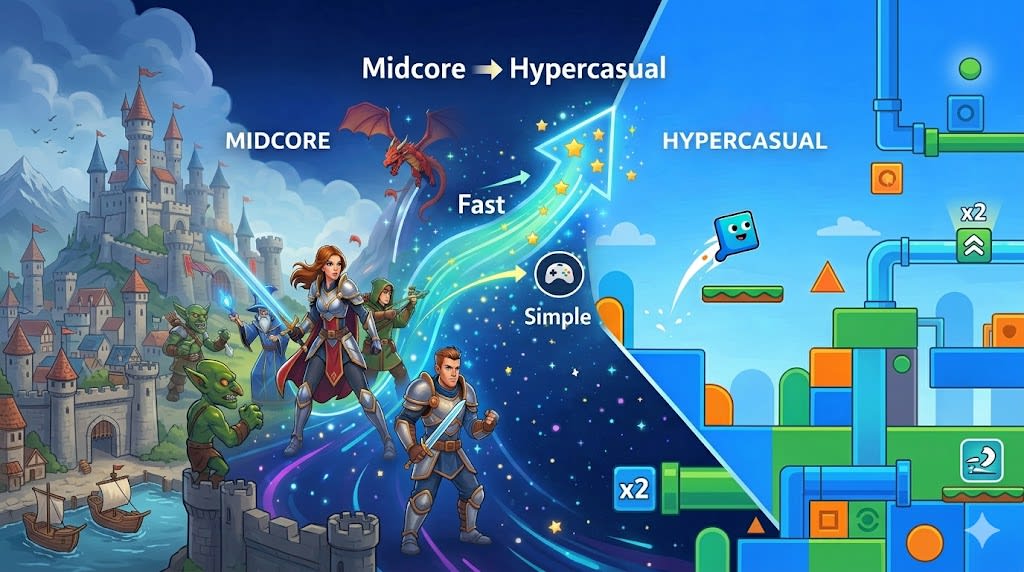
For years, the game market has been neatly segmented: hypercasual focuses on simplicity, instant accessibility, and short play sessions, while midcore and AA titles prioritize system depth, long-term retention, and monetization. But this boundary is starting to blur. A key insight many teams overlook is that midcore games don’t just benefit from hypercasual principles—they increasingly depend on them at the experience layer.
At a high level, hypercasual games are extremely optimized for the first-time user experience (FTUE). Within the first 30–60 seconds, players make a critical decision: stay or churn. Every interaction is designed to minimize friction and maximize clarity. In contrast, many midcore games frontload complexity—long tutorials, multiple systems, delayed feedback loops—creating high cognitive load before players even understand why the game is fun.
The issue isn’t that midcore games have too much depth. The issue is when and how that depth is introduced.
A useful way to frame this is by separating the game into two layers:
Interaction Layer: what the player actually does moment-to-moment
System Layer: progression, economy, meta systems, monetization
Hypercasual games almost exclusively operate in the interaction layer, but they polish it to near perfection. Midcore games, on the other hand, invest heavily in the system layer but often neglect the clarity and immediacy of interaction.
From a product perspective, this creates a mismatch between acquisition promise and actual experience. Players are often attracted by a simple, clear core loop (usually via ads), but once they enter the game, they’re immediately confronted with systems that haven’t been properly “translated” into intuitive interaction. This gap leads to confusion, friction, and ultimately early churn.
So what should midcore teams do?
1. Compress the Core Loop
The core loop needs to be immediately playable and understandable. Players should experience input → feedback → reward within seconds. You don’t need to expose the full system—just a distilled version that delivers the core feeling.
2. Delay Complexity, Not Depth
Depth should exist, but it shouldn’t be frontloaded. Systems like upgrades, currencies, or skill trees should unlock progressively. Players should earn their understanding over time, not be forced into it upfront.
3. Treat Tutorial as Gameplay
Tutorials should not feel like a separate layer. The best onboarding happens when players learn by doing, not by reading or being instructed.
4. Optimize for Micro-Retention
Instead of only tracking D1 or D7 retention, focus on early-session signals: completion rate of the first level, time to first success, retry behavior in the first few minutes. These metrics reveal where friction actually occurs.
5. Maintain Visual Clarity
Even with deeper systems, the cause–effect relationship in gameplay must remain clear. Players should always understand what just happened and why.
Basically, midcore games don’t need to become hypercasual. They need to adopt the discipline of simplicity at the interaction layer, while preserving depth in the system layer.
This is not just a design problem—it’s a product strategy problem. As acquisition costs rise and attention spans shrink, the window to prove value is getting shorter. If a game cannot communicate its core appeal within the first few minutes, its long-term systems become irrelevant.
The real leverage lies in building a smooth bridge from simplicity to complexity. Hypercasual has mastered the entry point. Midcore must ensure the transition doesn’t break the experience.
6. Design for “Instant Legibility”
One additional principle worth emphasizing is instant legibility—the ability for players to understand the game state at a glance without explanation. This goes beyond UI clarity; it’s about making the game self-explanatory through motion, feedback, and spatial logic. When players can predict outcomes before interacting, they feel in control. When they feel in control, they engage deeper. Hypercasual games excel at this by making every action visually and systemically obvious. Midcore games should apply the same principle, ensuring that even as systems scale, the moment-to-moment readability remains intact. This is especially critical on mobile, where sessions are short and attention is fragmented.
The real question is not:
“Is the game deep enough?”
But rather:
“Do players feel the value before they leave?”
About the Creator
Keep reading
More stories from Anh Dong Nguyen and writers in Gamers and other communities.
You’re Not “Born Smart” — 5 Habits That Rewire Your Brain
Most people believe intelligence is something you’re born with — fixed, limited, and mostly out of your control. It’s a comforting idea in some ways. If intelligence is fixed, then there’s no pressure to change it. You simply accept where you are and move on.
By Anh Dong Nguyena day ago in Psyche
Early Life and Playing Career
Early Life and Playing Career Born on January 18, 1971, in Santpedor, Spain, Pep Guardiola developed a passion for football at a young age. He joined the famous youth academy of FC Barcelona, known as La Masia, where he honed his skills and understanding of the game. Guardiola played as a defensive midfielder and became a key figure in the legendary “Dream Team” under Johan Cruyff.
By Muzamil Gul2 days ago in Gamers



Comments
There are no comments for this story
Be the first to respond and start the conversation.