Everyday Junglist
Bio
About me. You know how everyone says to be a successful writer you should focus in one or two areas. I continue to prove them correct.


Stories (715)
Filter by community
AI Continues to Transform Our Lives Through the Transformative Power of Transformation
AI has transformed so many lives already. How could it possibly be any more transformative? Personally I have seen my own life completely transformed since AI was first was dumbed down and redefined to mean modern computing and not anything actually intelligent. My city’s traffic light system has never run more smoothly, and the elevators in the high rises downtown move people up and down with greater efficiency then ever before. The skies above our airports are full of planes calmly preparing for on time arrivals, instead of plunging to their dooms two hours late like back in the old days before AI. Plus my phone is smart and so is my house. It seems like everything is transformed beyond my wildest imagination. AI is the ultimate transformer. AI-bots, transform and roll out!
By Everyday Junglist2 years ago in Poets
I Married a Dragon . Top Story - March 2024.
My wife is a polymath and highly accomplished research scientist who skipped high school to attend college at the age of 14 which speaks to her intellectual capabilities. She holds a masters degree in microbiology and immunology from the University of Virginia (She was robbed of her Ph.D. by a professor who stole her work and patented it preventing her from publishing, effectively ending her academic research career, a thing which happens far too often, and which happens to female graduate students far more frequently than to their male counterparts.) and has a long list of publications as both lead author and co-author in the peer reviewed scientific literature, including a most recent second authorship in the prestigious journal Science. She has worked with highly dangerous pathogens for much of her career, and is a recognized expert on Yersinia pestis (Bubonic plague), and Bacillus anthracis (Anthrax). Lest you think she is some pale skinned lab nerd who has spent her entire life locked in a lab chained to a bench, she has also been a field biologist. She worked for five years in the Daintree Rainforest in Australia chasing down the source of mycobacterium ulcerans, cause of a terrible skin disease that plagues indigenous populations there. The Daintree is often called the most dangerous forest in the world, and is not a place most people would want to visit for a day, let alone work in, five to seven days a week for five years.
By Everyday Junglist2 years ago in Humans
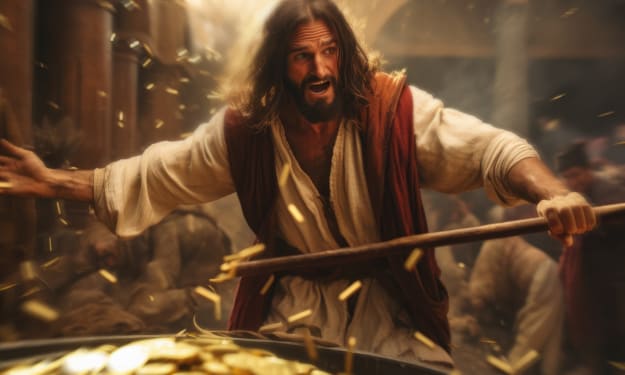
Jesus Saves at Temple Market
Jesus Christ, lord and savior to tens of millions of Christians worldwide, reportedly saved big at the temple market during his last shopping trip to the large Jewish temple market near his home in Nazareth. Though he has been permanently banned from the market for disrupting business by violently turning over money changer's tables during previous visits he still shops there regularly in disguise. The son of God saved close to fifteen percent off of regular prices on fish heads, mulled wine, and bread loaves by buying them from the clearance rack at the back of the temple and not near the front entrance where they are generally found at much higher prices. After leaving the store with almost 100 drachma remaining from his budget of 200 dinar Jesus was reportedly quite pleased with how much he had saved saying the following "They say give to Ceaser what is Ceaser's and give to God what is God's. Oh wait, I mean, I say that, or, I said that. Not sure exactly where I was going with that, but man did I save big today. I mean I saved a lot. Nice!" With that Jesus bowed his head, turned and walked away.
By Everyday Junglist2 years ago in Poets
Could Love Actually Be a Net Negative for Humanity
Introduction I am not one to complain about tests being too hard. In fact, generally speaking, the more difficult any given challenge, the more compelling I find it. Even for me however to "write a personal reflection that explores the complexities of love" is a challenge for which I must cry uncle. To find something interesting, and more importantly, something which has not been said a million times before, by a million other people a million times more talented than me, about a topic that may the most thought and written about in the history of humanity, is likely not possible for a person of my limited abilities. That said, since I am already sitting here at the computer and fully committed to writing something, and since I have also decided that no matter what the outcome I will submit it to the above referenced challenge, I must go on, and if you are a are a fan of intellectually stimulating run on filled ramblings, then I invite you to read on. What is to come will no doubt not exactly fit the criteria of the aforementioned challenge for which this piece is being penned. However, in the spirit of difficult challenges I challenge the judges and you the reader, to try and find a way to make it fit. If I am up to the challenge surely you can be too.
By Everyday Junglist2 years ago in Humans
Analogy Does Not Recapitulate Reality
The Possibility of Analogy Does Not Necessarily Correlate with the Probability of Reality I take a hard line against the currently (and formerly) in vogue position of equating human beings, particularly their brains, with computers. To me it is obvious that no such equivalence exists despite decades of suggestions otherwise. The number of analogies between various structures/functions of the human brain and those of a computer/computer system are as large as the number of neurons estimated to comprise said brain. The prevalence of these analogies often makes us forget that they are only that, analogies. They are not based in scientific fact, but instead are based in the imaginative capacities of the organ which is the topic of these comparisons. The possibility of analogy is however often confused with the probability of reality. Those things for which we can analogize more are thought to be more accurate representations of the real relationships of the things being compared. Therefore, because there are so many analogies possible between how (we hypothesize) a human brain works and how a computer works, it must be true that a human brain is very similar to, or exactly like, a computer. The point of analogies is (or should be) to help clarify/deepen our understanding of a thing through a comparison of that thing and/or it’s attributes with another (usually similar but not always) thing. We suggest that the first thing is like the other because of x, y, and z and the comparison allows us to see the thing we are trying to clarify our understanding of in a different way. To ‘see’ it anew. In no way however is the analogy an argument (it is not an argument and should not be viewed as such) as to the actual similarity (in point of fact/reality) of the two things. It is for illustrative purposes only and carries no truth value or “reality bestowing” power. Analogies are powerful, but they are not all powerful. They can clarify but they can also mislead. We must not confuse our ability to create analogies with our ability to clearly see, study, and understand reality.
By Everyday Junglist2 years ago in Poets
Inverse Simplified
Top To Bottom Author's postscript: I am appending this postscript only because apparently Vocal also has a 5 word minimum for all published works. The in addition to the 600 word minimum it has for most published works, except for during some challenges and in the Poets community where it is normally 150 words, or something like that. Get rid of the stupid word count minimums already Vocal. Gheesh. How many times do I have to keep dumping on you about this before you will finally listen? In order to write the worlds simplest inverted poem less than five words will almost certainly be required.
By Everyday Junglist2 years ago in Poets
Immunity from Evil
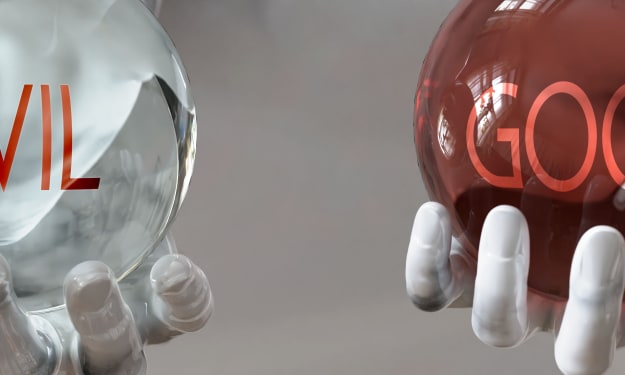
I wrote a piece a few years ago where I asked the question if it were possible for an evil man to be as critically self aware of his nature as a good man? I recently reposted it here. I encourage you to read that piece first as it provides some background and perspective for the following discussion. Here I ask a slightly different, but similar and related question. Are there any religions in which it would be impossible for a truly evil person to participate? How one "participates" in any given religion varies almost as widely as their basic moral tenets. For purposes of this piece I simply mean be recognized by other "members" of the religion as a "member in good standing" or as a "true believer" or "true adherent" of the given religion or faith tradition. Obviously since the person is actually evil, for almost all religions, save perhaps Satanism and maybe a few others, this would have to be by deception. So the question really boils down to this, Are there any religions which by their very nature, their very structure, would absolutely prevent an evil person from "participating" by deception? Or, another way to phrase it, are there any religions absolutely immune from deception by an evil person?
By Everyday Junglist2 years ago in Humans
Can an Evil Man* be as Critically Aware of his Nature as a Good Man?
Typically it is supposed that all good men possess similar key attributes. They have the ability to rigorously and thoroughly reflect on the nature of themselves. They fully comprehend the impact on others of their decisions and appreciate their role in contributing to or reducing the suffering of others. They feel deeply the emotions needed in order to achieve a correct understanding of these things. Emotions like empathy, sadness, guilt, shame, and others. They recognize that most people seek to maximize their experience of positive emotions and minimize the experience of negative ones. Thus they act in ways which seek to achieve this balance in the greatest number of people. They also recognize that all people are unique and all situations different. The optimum emotional balance for one person in a certain situations may vary with other persons in different circumstances. They are flexible enough to adjust accordingly to those differences and wise enough to understand when a certain balance should be aimed for given the circumstances.
By Everyday Junglist2 years ago in Humans
Yeti Encounter
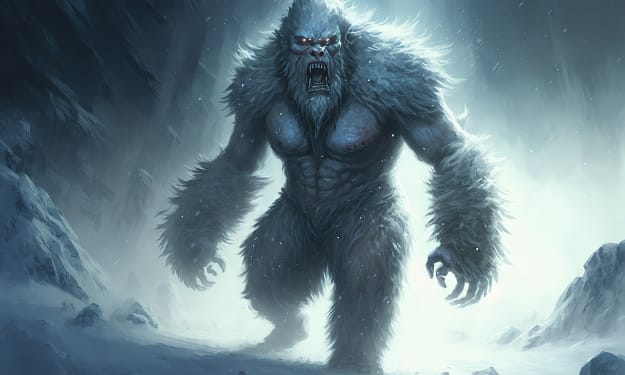
The Yeti came out of nowhere. The wind was howling and all I could see was blowing snow and ice and blackness and then suddenly it was there right in front of me. The creature had to be at least twelve feet tall. It's fur was white as purest snow, but matted and coated in ice. Disturbingly, blood could been seen, no doubt from a recent kill, dripping from the giant fangs which protruded from its bear-like face. When it roared the blood flew from its mouth splashing in rivulets on the snow, melting it partially where it landed and turning it from white to red. I was so close that some of the blood splattered across my face. I could taste the iron in it as it dripped down along into the corners of my mouth. I spat out the acrid blood and immediately reached for my sidearm. Fortunately I had just removed my gloves as I had stopped to light a fire or surely I would have had no chance. I drew the gun as quickly as possible and fired off three shots in quick succession. The noise was deafening as it echoed off the canyon walls. The creature fell back just as an avalanche, triggered by the noise of the gun crashed down upon us both. We fell together, tumbling down the side of mountain carried away by the rushing snow mixed with mud and rocks. I blacked out then and awoke five days later. Still alive.
By Everyday Junglist2 years ago in Fiction