
The Trauma of Training
My 70% disability from the war was my greatest teacher, proving that empathy builds more muscle than any drill sergeant ever could.

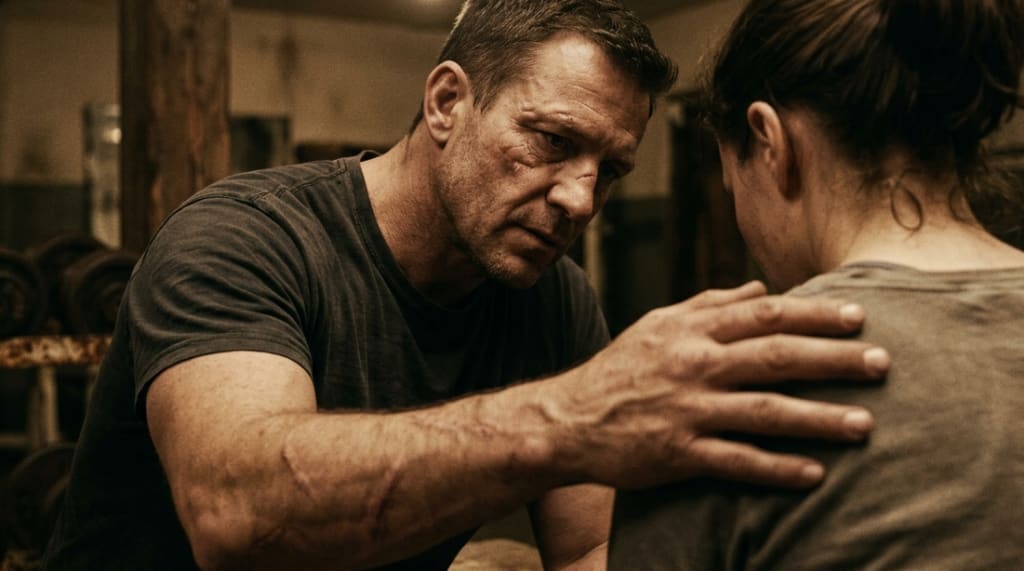
I carry 70% of a war’s destruction in my limbs. It taught me more about fitness than any textbook ever could.
In the dim light of the gym’s neon, I often sit and watch the same hollow performance. It’s a drama of missed connections.
There’s the young trainer, leaning against the cold steel of a squat rack, his eyes glued to a glowing screen while his client moves like a ghost beside him. They are talking about nothing—mindless chatter to kill the time they’re supposed to be using to rebuild a life. Then there’s the "alpha" coach, barking commands at a woman whose eyes are clouded with the exhaustion of a ten-hour workday. He thinks he’s building grit; he’s actually building resentment. And the students? The ones dreaming of a "fitness empire"? They look at the human body and see a set of pulleys and levers, a mechanical problem to be solved for a fee.
Every time I witness this, a familiar ache returns to my chest. It’s not just frustration—it’s a deep, empathetic grief. I see the emotional dissonance vibrating in the air. I see people reaching for help and being met with a cold, plastic script.
The Ghost of the Field
My mother used to look at my work with a sharp, peasant wisdom. “You get paid to watch people lift iron?” she’d ask, her voice dry as the earth. “Go find a field and a hoe. That’s work. This? This is nonsense.” For a long time, I thought she just didn’t understand. Now, I realize she saw the truth before I did. If a trainer is just a glorified stopwatch, then she was right—it is nonsense. It’s a scam. You don’t pay a trainer for their knowledge of anatomy. You pay them to be the architect of your confidence. You pay them to hold the space when you feel too heavy to move. You pay them for the psychological sanctuary they are supposed to build around you.
Out of a hundred trainers I see, fifty shouldn't be allowed near a human heart. Twenty-five more should be sent straight to a psychology ward—not as patients, but to learn how to look a suffering person in the eye. Because if your spirit is as rigid as the weights you carry, your expertise is a dead language.
Forged in the Fire
My credentials aren't written on paper; they are carved into my legs, my arms, my lungs, and my face. I am 70% broken by the fires of war.
When you’ve had to crawl back to life, inch by agonizing inch, you develop a different kind of sight. You don't see "clients"; you see survivors. I am not a person you can approach with a "standardized" program. If I hadn't become a trainer myself—if I hadn't bled over my own recovery—who would have known how to handle me?
Imagine a man carrying the weight of a war walking into a modern, glossy gym. If a trainer lacks the soul to sense that weight, they don't just risk a bad workout; they risk shattering a person’s fragile peace. In my world, the coach and the healer are the same person. But the healing doesn't start with a bicep curl. It starts with the visceral feeling of being safe.
I’ve learned that the human connection is the only foundation that won't crumble. Training should feel like a dance—fluid, rhythmic, and alive. I’ve always believed that "less is more." I’d rather lead you through a circuit that makes you feel "awake" and vital than grind you down into a machine that just knows how to follow orders.
The Shield of the Body
For so many, walking into a gym feels like walking onto a stage naked. They feel judged, exposed, and small. This is where a trainer’s Emotional Intelligence (EQ) must become a shield.
A real trainer knows how to read the silence. They know how to position themselves to block the judgmental stares of the "perfect" crowd. They use their own presence to create a bubble of intimacy where the client can finally let go.
"We all have that eighteen-inch circle around us. Our intimate space. You have to earn the right to stand there."
In that circle, we aren't just moving iron; we are repairing a broken self-image. The heavy lifting only truly begins when the client finally exhales—when they realize they aren't being watched, but seen. Results are just the shadow cast by a deep, trusting relationship.
Concrete and Compassion
A friend of mine who runs a construction company once told me the secret to his success. It wasn't the concrete; it was the psychology. His men were tough, often uneducated, and scattered. To build a house, he first had to build a bridge into their minds. He had to understand their struggles before he could ask for their sweat.
The fitness industry has lost this pulse. We scream about calories and personal records, but we ignore the human being standing right in front of us. We forget that we are trespassing on someone’s intimate ground.
The Final Rep
I’ve stepped away from the daily grind of the gym floor to find other paths, but my heart still burns when I see that cold disconnect. It is so easy to fix a person’s grip. It is nearly impossible to teach a stone how to feel.
Maya Angelou said it best: "People will never forget how you made them feel."
That is the only metric that matters. If we want to be more than just "iron-movers," we have to stop training muscles and start training our humanity. Because at the end of the day, no one is really looking for a six-pack. They are looking for the version of themselves that isn't afraid to be seen. They are looking for the strength to feel alive again.
About the Author: A survivor who knows that the heaviest weights aren't in the gym, and the only muscle that truly matters is the one that beats in your chest.
About the Creator
Feliks Karić
50+, still refusing to grow up. I write daily, record music no one listens to, and loiter on film sets. I cook & train like a pro, yet my belly remains a loyal fan. Seen a lot, learned little, just a kid with older knees and no plan.
Keep reading
More stories from Feliks Karić and writers in Viva and other communities.
Why I'm Using Secret Military Survival Rituals to Fix Burned-Out CEO's
The Frequency of Survival: Why I Don’t Care About Your Squat PR I’m an anti-talent for business. Let’s just start there. I don’t have a marketing funnel, my Instagram is a disaster, and for years, my "price list" was basically whatever my gut told me was right in the moment. If you’d told me thirty years ago, while I was clutching a rifle in a frozen Croatian trench, that I’d spend my fifties gently rubbing the forehead of some high-powered executive who’s on the verge of tears from exhaustion. I’d have thought you were shell-shocked.
By Feliks Karićabout a month ago in Viva
Why Mozambique’s Island Getaways Are Among Africa’s Most Enchanting Beach Destinations
Mozambique’s coastline does not announce itself loudly. It runs along the Indian Ocean without drawing much attention to itself, opening up to islands that feel far removed from busy travel routes. These are not places built around crowds or constant movement. Instead, they unfold gradually, guided by tides, weather, and light. Understanding why Mozambique’s island getaways are among Africa’s most enchanting beach destinations begins with recognising how little has been altered—and how much that changes the experience.
By Daphne Olga6 days ago in Viva
A Visitor's Guide To Victorian England
A Book Review Being interested in all things Victorian, I am constantly looking for books on the Victorian Era. In fact, I should admit that I am obsessed about ‘all things Victorian’. From the clothes worn by men and women, rich or poor, to how they lived, where they lived, what they ate and would (or would not ) drink, what kind of transport there was, who worked where, who went to school (and who didn’t), the list really is endless.
By Ruth Elizabeth Stiff4 days ago in BookClub



Comments
There are no comments for this story
Be the first to respond and start the conversation.