
The Fast Pick Problem
Why Shelter Choices Mislead

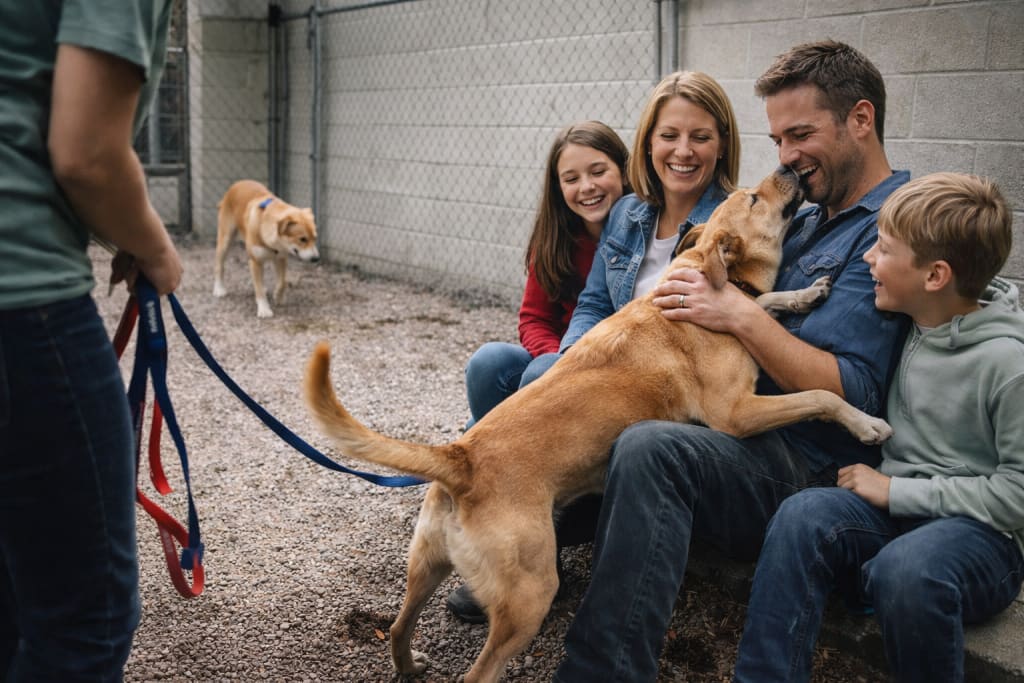
The meet-and-greet lasts about 12 minutes.
A volunteer opens the door and brings in 2 dogs. One heads straight for the family, tail moving hard, body loose, climbing halfway into a lap before the adults have even settled into their chairs. Everybody laughs. The kids light up. Somebody says, “Well, I guess we know who picked us.”
The other dog stays back for a moment. Not frozen. Not panicked. Just slower. Nose down. A quick sweep of the wall. A pause near the chair leg. A glance toward the people, then away again. The mood in the room shifts almost immediately. The fast dog feels like the obvious answer. The slower dog starts losing the race before anybody has actually learned much of anything.
That is the problem.
People make a lot of shelter decisions by confusing fast approach with a better long-term fit. It feels natural because humans are wired to respond to immediacy. When something moves toward us quickly, warmly, and with visible enthusiasm, we experience that as connection. We feel chosen. In a shelter, that feeling can overpower almost everything else in the room, including common sense.
The first dog to rush over is not always the dog who will regulate best in a home.
Fast does not mean stable.
A dog who approaches quickly may be social and well-adjusted. That happens. But fast approach can also reflect high arousal, overstimulation, poor impulse control, stress, frantic contact-seeking, or a history of learning that immediate engagement produces attention. In a loud shelter, where routines are broken, scent is everywhere, and nervous systems are already loaded, behavior gets louder than it would be in ordinary life.
A dog moving fast is not automatically showing you affection in the deep way people imagine. Sometimes the dog is showing intensity. Sometimes uncertainty comes out as motion. Sometimes confinement itself produces the kind of charged behavior people mistake for friendliness because it is easier and more flattering to believe the dog instantly fell in love with them.
I have seen this same human error in other settings too. People assign meaning too early because early meaning feels good. It lowers uncertainty. It gives them a story. But a quick story is not the same thing as an accurate one.
Slow does not mean disinterest.
The quieter dog often gets misjudged for the opposite reason. Humans see delay and start filling in blanks. They assume the dog is detached, less affectionate, shy in a permanent way, poorly socialized, or somehow less compatible. In many cases, that conclusion is flat wrong.
A slower dog may simply be assessing the room before engaging. That is not a flaw. It can reflect caution, sensory processing, uncertainty in a new space, or a more measured way of approaching novelty. Some dogs do not advertise themselves well under pressure. Once they leave the shelter environment and their nervous system stops taking hits from constant noise and disruption, much more of their actual temperament becomes visible.
Shelters do not give animals the luxury of being fully known.
That is one of the hardest truths in adoption work. People are making major decisions in compressed time, in artificial conditions, while both they and the dog are under stress. Then everybody acts surprised when the first impression turns out to be incomplete.
A snapshot is not a biography.
This is where people go wrong. They take a 10 to 15 minute interaction and treat it like a full character reference. It is not. It is a snapshot taken under pressure.
Short observations can tell you something useful. They can show whether a dog startles easily, whether recovery happens at all, whether contact sends arousal higher, whether handling seems to create panic, whether interruption leads to flexibility or escalation. Those things matter. But they do not give you a finished portrait of who that dog is going to be after 3 weeks in a stable home with sleep, routine, predictability, and less sensory overload.
State is not the same thing as trait.
That difference gets ignored constantly in shelters, rescues, media clips, and public conversation about dogs. A dog under strain may look hyper, flat, clingy, avoidant, shut down, overfriendly, or unusually intense. Those behaviors may reflect the setting more than the dog’s settled baseline.
The public tends to reward whatever is easiest to interpret in 30 seconds. Real compatibility takes longer than that.
What to watch instead.
A better meet-and-greet slows the whole moment down and pays attention to a few less glamorous things:
- How the dog transitions into the room
- How the dog handles mild interruption
- Whether contact lowers arousal or drives it higher
- How the dog disengages after engagement
- Whether the dog can re-settle without falling apart
That last part is more important than people think.
A dog who can move toward you, connect, settle, and then reconnect is showing flexibility. That tells you more than the first leap into your lap ever will. A dog who keeps escalating with no visible recovery may still be a good dog, but the home may need far more structure and regulation support than the family realizes in that euphoric first meeting.
Neither dog is automatically the wrong choice.
The problem starts when people select on intensity alone.
This happens with cats too.
Cats get misread for the opposite reason. In shelter spaces, the cat who walks forward immediately, rubs the cage door, or solicits contact often gets labeled friendly and easy, while the cat hanging back gets written off as aloof, unfriendly, or less bonded to people. That is the same error in a different form. Cats are also responding to noise, confinement, scent overload, handling history, and stress. A quieter cat may become deeply social once the environment stops hitting the nervous system every few seconds. A fast-approach cat may remain wonderful, but the point is the same: first presentation is not the whole animal.
The humane mistake with dogs.
There is also a human tenderness problem buried in this. People want the dog who seems to need them most in the most obvious way. That instinct is understandable. It can also be misleading. High-contact behavior can pull at people hard because it feels emotionally rewarding and morally flattering. The dog appears grateful, bonded, relieved, relieved by you specifically. That story can form in seconds.
- Sometimes it is true enough.
- Sometimes it is fantasy layered over arousal.
The quieter dog, meanwhile, often gets penalized for not performing emotional ease on command. That is not a small injustice. It means the dogs who market themselves best in a stressful room can get chosen over dogs whose regulation may actually fit the household better.
What people should remember.
Shelter behavior is not simple. It is behavior under pressure. That is why it has to be interpreted with more discipline than most people bring to it.
The first dog to run toward you may be wonderful. The last dog to approach may be wonderful too. The point is that neither conclusion should be made just because one dog created a faster emotional payoff.
Compatibility is not always flashy.
In most cases, the better clues show up in recovery, flexibility, and the dog’s ability to come down after stimulation. Those are quieter things. They do not produce the same instant rush in a meet-and-greet room. They do, however, tend to matter a lot more once the dog is home and the real life begins.
A 12-minute burst of enthusiasm can be memorable. But It should never be mistaken for evidence.
______________________
Sources That Don’t Suck
American Society for the Prevention of Cruelty to Animals. (n.d.).
Brady, K. (2018). A systematic review of the reliability and validity of canine behavior assessments.
Clay, L. (2020). Do behaviour assessments in a shelter predict post-adoption behavior?
Powell, L. (2022). Returning a shelter dog: The role of owner expectations.
McGuire, B. (2021). Results of behavioral evaluations predict length of stay in shelter dogs.
About the Creator
Dr. Mozelle Martin
Behavioral analyst and investigative writer examining how people, institutions, and narratives behave under pressure—and what remains when systems fail.
Keep reading
More stories from Dr. Mozelle Martin and writers in Petlife and other communities.
Wisteria Woo RIP
Wisteria Woo Silver~Rhodesian Ridgeback Cane Corso mix~ 7.19.15-3.2.26 My service dog, Wisteria, had been slowing down, having mysterious health symptoms like severe hives and unexplained injury. She went to the vet last month, but unfortunately, not all tests detect all problems. When we returned to the vet yesterday, upon much more concerning symptoms suddenly appearing, we learned she had a very large mass (10inx10in) likely the very aggressive hemangiosarcoma, and that we would only be buying a few months if we went through with treatment.
By K.B. Silver 26 days ago in Petlife


Comments
There are no comments for this story
Be the first to respond and start the conversation.