
Godfrey de Bouillon
A French Noble, Brave Soldier & a bit of a chef
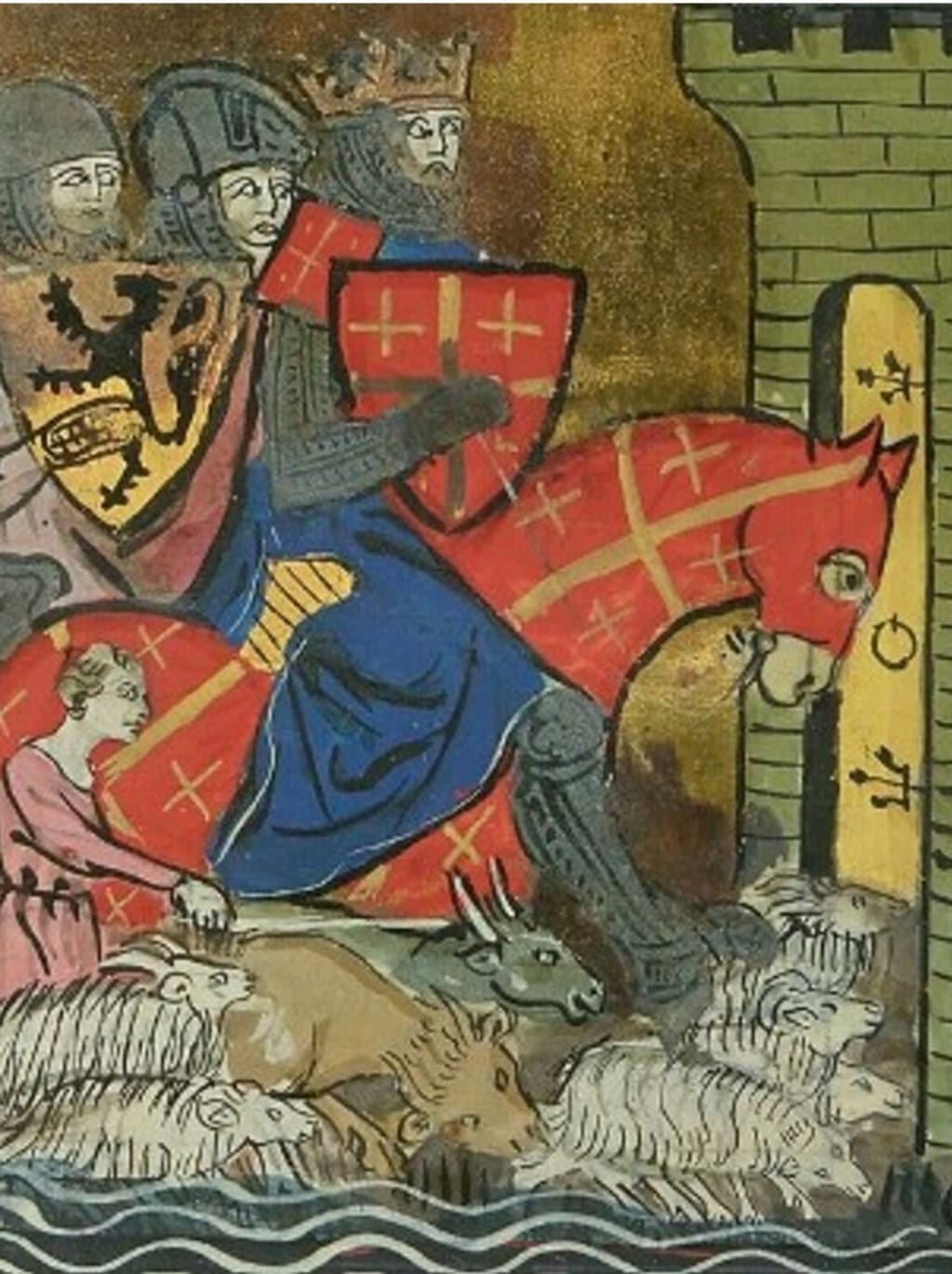
Godfrey de Bouillon was born around 1060 into the French nobility in the Boulogne region of France.
His father served William the Conqueror, survived the Battle of Hastings but died quite young leaving a very young Godfrey and his two brothers with their mother for their upbringing. Godfrey began his military training around about the age of ten and became a proficient horse rider, swordsman and bowman.
At the age of 17 he joined the forces that fought against the Saxon Revolt (1077-1088). It was during this revolt that he rose to prominence as a brave and loyal soldier. For these qualities Emperor Henry IV confirmed as the Duke of Lower Saxony in 1082.
It was during the Saxon Revolt, and despite his wealthy background, that he demonstrated a rare compassion for those who served under him. This was regardless of their backgrounds and upbringing. He always made sure that they were well supplied with the appropriate weaponry, clothing and food. Even if this meant funding these supplies from his family's wealth.
In 1095 Pope Urban II called for a Holy Crusade to free the City of Jerusalem from the non Christian Fatimids.
There was a period of about four months during which the various factions of the Crusade militia were able to organise themselves for the challenging and arduous journey to Jerusalem. It was during this period that as well as making sure his own troops were well prepared with clothing and equipment that Godfrey worked with his mother in the castle kitchen on something to supplement the vagaries of the soldiers diets as they advanced towards the Holy City. He and his mother were helped by the kitchen staff and the gardeners.
They spent many hours preparing broths and stocks but these proved bulky and difficult to transport. The way the army was predicted to progress they would have to be used before they reached the ports on the south coast of France otherwise they would turn rancid and unusable. Godfrey and his mother wanted something that would last longer.
After a long day in the castle's kitchens the household retired to their beds. The next morning when they came back there was a warming soft aroma filling the room. Someone had left a pot and its contents on the fire. The contents had dried out with the constant heat leaving a solid mass in the pot. As the cook began to chip away at the contents of the pot Godfrey and his mother came in. The cook was putting the chunks on the kitchen table in readiness to be fed to the pigs as waste.
Godfrey and his mother picked up one of the chunks, crumbled them and were wafted over by the same warming aroma that had permeated the castle overnight. They gathered some of the powder into a beaker, poured hot water into it and the dried powder that was going to fed to the pigs as waste was transformed into a soup, a broth or a stock.
The kitchen was frantically set to work as the date of departure on the Crusade approached. By the time Godfrey left Boulogne every officer and man that was serving with him had the equivalent, in today's terms, of a kilo of this wonderful powder that could be used with hot water as a warming drink or as a base for soups, broths and casseroles.
The Crusaders eventually took the City of Jerusalem and it is there that Godfrey was enthroned as The First King of Jerusalem and lived out his days until he died at about the age of forty in 1100.
That powder, made entirely by mistake, in castle's kitchen in Boulogne over a thousand years ago has become a staple throughout the culinary world. And, yes, has the universal name of bouillon in memory of the man who was responsible for making sure his troops ate well on their Crusade.
About the Creator
Alan Russell
When you read my words they may not be perfect but I hope they:
1. Engage you
2. Entertain you
3. At least make you smile (Omar's Diaries) or
4. Think about this crazy world we live in and
5. Never accept anything at face value
Keep reading
More stories from Alan Russell and writers in Humor and other communities.
Bibbidi-Bobbidi-Booyah!
Dear Professor Donkeldong, I would like to formally apologize. Last night I snuck into your office. I sat in your chair and poured myself three fingers of Scotch from the bottle you’ve got stashed in the top desk drawer. Then I helped myself to your private library.
By Leslie Writesabout 3 hours ago in Humor



Comments
There are no comments for this story
Be the first to respond and start the conversation.