
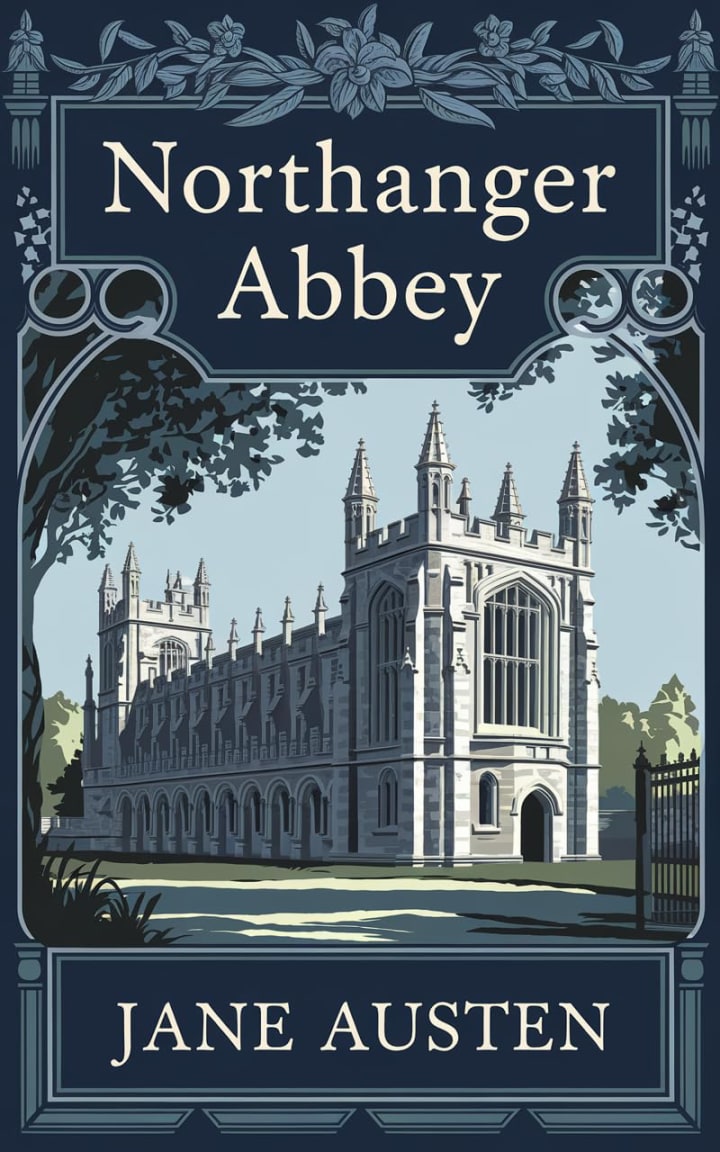
Northanger Abbey by Jane Austen
Why It's a Masterpiece (Week 109)

Background and Context:
This is going to be pretty short but 'Northanger Abbey' is my favourite Jane Austen novel. Which is yours? If you haven't read any Austen then don't feel bad - 'Northanger Abbey' is probably one of the simpler ones to read if you would like to start there! Happy reading to you and yours.
Northanger Abbey by Jane Austen
This novel was written between 1798 and 1799 and not published until after the death of its author, Jane Austen. One of her earliest completed novels, it was a satire on the Gothic novel and sold to a publisher in 1803 for the price of £10. It wasn't published until 1817 alongside Persuasion, only months after Jane had passed away. It makes some very obvious references to the novel The Mysteries of Udolpho by Ann Radcliffe, using the obsession and melodramatic tropes of the genre itself to critique social conventions and gender expectations with Austen's classic sharp-tongued wit being intertwined within. Unlike her other books, this one is more explicitly funny and comical, it is also more self-aware in which the narrator of the book speaks directly to the reader from time to time.
Plot
Catherine Morland, the seventeen-year-old daughter of a clergyman, is an unlikely heroine: ordinary, unremarkable, and largely ignorant of the world. Despite her love for reading, particularly Gothic novels, she is naïve and inexperienced in matters of society and romance. When family friends, the Allens, invite her to accompany them to Bath, she eagerly accepts, seeing it as an opportunity for excitement and adventure.
In Bath, Catherine befriends Isabella Thorpe, a lively and seemingly charming young woman who shares her love of Gothic fiction. Catherine also meets Isabella’s brother, the boastful and insincere John Thorpe, who takes a romantic interest in her. However, Catherine is far more drawn to Henry Tilney, a witty and intelligent young clergyman, and his kind sister, Eleanor.
As Catherine becomes entangled in Bath society, she begins to see the true natures of those around her. Isabella, despite claiming to be devoted to Catherine’s brother, James, soon shifts her affections to Captain Frederick Tilney, revealing her superficiality. Meanwhile, John Thorpe repeatedly lies and manipulates Catherine in his attempts to secure her affections.
Catherine is delighted when she receives an invitation to visit the Tilney family estate, Northanger Abbey. Having read numerous Gothic novels, she imagines the abbey as a mysterious and possibly haunted mansion, filled with dark secrets. Influenced by her reading, she becomes convinced that General Tilney, Henry and Eleanor’s father, may have murdered or imprisoned his late wife. However, her suspicions are soon proven ridiculous when Henry gently rebukes her for letting fiction cloud her judgement. Mortified by her mistake, Catherine realises the dangers of excessive imagination and resolves to be more grounded in reality.
Just as she begins to settle at Northanger Abbey, General Tilney suddenly orders Catherine to leave, treating her with shocking rudeness. She returns home, heartbroken, believing she has somehow offended the Tilney family. Later, Henry arrives and explains that his father had initially believed Catherine to be wealthy, but after learning otherwise from John Thorpe, he cast her out. However, Henry defies his father’s wishes and proposes to Catherine, and she joyfully accepts. The novel ends with their marriage, and Catherine, though still fond of novels, has gained a more mature and realistic outlook on life.
Into the Book
A Parody of the Gothic Novel:
This novel is a sharp parody of Gothic fiction. Catherine, as an avid reader of gothic novels, expects her life to mirror the thrilling, suspenseful plots of her favourite books. Her arrival at Northanger Abbey is a turning point in the novel, as she becomes convinced that the abbey holds dark secrets. She imagines General Tilney as a villainous figure, suspecting him of having locked away or even murdered his late wife. However, Henry Tilney quickly dispels this.
This moment is a strange one for Catherine’s character development. She realises that the world is not a Gothic novel and that real-life villainy is far less dramatic but no less harmful: Isabella’s deceit and General Tilney’s arrogance, for instance, are more damaging than any imagined horror.
By satirising Gothic tropes, the author critiques the way our excessive imaginations can distort reality, particularly in young women influenced by popular literature. However, she does not condemn novel-reading entirely. Instead, she suggests that fiction is valuable as long as it is balanced with rationality and discernment. Something that eras such as 'reading fever' will not heed to.
“Remember, we are English, that we are Christians. Consult your own understanding, your own sense of the probable, your own observation of what is passing around you.”
- Northanger Abbey by Jane Austen
Marriage:
The author critiques the way marriage is often treated as a financial transaction rather than a romantic union. General Tilney initially welcomes Catherine under the false impression that she is wealthy, treating her with great hospitality. However, once he discovers the truth about her modest background, he abruptly expels her from the Abbey, showing how marriage and wealth are intrinsically linked in the minds of the upper classes.
Henry Tilney’s rejection of his father’s materialistic values makes him a true romantic hero. When he proposes to Catherine, he does so for love, disregarding his father’s disapproval.
Henry’s sincerity contrast with characters like Isabella Thorpe, who pursues men based on their financial prospects. Through these contrasting relationships, Austen highlights the importance of marrying for love rather than status.
“I am sure of nothing so little as my own merit.”
- Northanger Abbey by Jane Austen
A Woman Maturing:
Catherine begins the novel as an impressionable and naïve girl but matures into a more self-aware and discerning young woman. Her growth is central to the novel’s message about the education of young women, not just in terms of formal schooling, but in learning to navigate society, relationships, and self-awareness.
By the end, Catherine has moved beyond her romanticised notions of life, love, and adventure. While she still enjoys novels, she no longer lets them dictate her perception of reality. This development reflects the author's own belief that women should be allowed to learn through experience and reflection rather than simply being sheltered or taught superficial accomplishments.
"Her mind made up on these several points, and her resolution formed, of always judging and acting in future with the greatest good sense, she had nothing to do but to forgive herself and be happier than ever."
- Northanger Abbey by Jane Austen
Why It's a Masterpiece
Northanger Abbey gets overlooked a lot in the works of Jane Austen as many regard it as a 'light' read. However, it is really the birth of Austen's sharp-tongue and her playful irony which shows an in-depth understanding of human nature and the fragility of it. Female education is part and parcel of the centre of this book and yet it seems like it isn't an 'academic' education - it is still an education in every other sense of the word. The self-conscious narrator mixed with the meta-fiction means that we as readers, get a unique insight into the book as we feel a part of it.
Conclusion
Northanger Abbey endures as a charming and insightful novel that combines humour, social critique, and literary satire. Austen’s exploration of imagination, personal growth, and the realities of marriage remains relevant, and her witty, engaging prose ensures that the novel continues to captivate readers. While it may not have the dramatic intensity that some appreciate of Pride and Prejudice or Emma, it is a delightful and clever work that highlights Austen’s literary genius.
A fantastic Jane Austen novel and definitely my favourite of them all (have I mentioned that?) the witty prose of Jane Austen endures and endures, leaving us reeling, laughing out loud and yet, strangely thoughtful about where this fits into our lives. It was identity consumerism before we had a word for it. How are we what we consume and when does it start to consume us?
A woman ahead of her time by centuries.
Next Week: Terra Amata by KMG Le Clezio
About the Creator
Annie Kapur
I am:
🙋🏽♀️ Annie
📚 Avid Reader
📝 Reviewer and Commentator
🎓 Post-Grad Millennial (M.A)
***
I have:
📖 300K+ reads on Vocal
🫶🏼 Love for reading & research
🦋/X @AnnieWithBooks
***
🏡 UK
Keep reading
More stories from Annie Kapur and writers in Geeks and other communities.
Book Review: "Queen Victoria" by Lucy Worsley (Pt. 2)
After the first couple of chapters, we have a good grounding for the raising of the Princess Victoria. Lucy Worsley takes us on a journey through malaise and sickness in which many did not know what was wrong with Victoria but, then we cover the beautiful love story she has with Albert. It's not quite all sunshine and rainbows but it's close enough. Lucy Worsley makes sure that we know that Victoria initially met Ernest (Albert's brother) and then continued to meet Albert. We are reminded that Victoria did not marry Albert until he had learnt a sufficient amount of English to be able to communicate effectively and we revisit that part of the introduction in our minds, in which Victoria states that after the death of Albert, she shall have to think for herself or at least, by herself, and that seems to scare her.
By Annie Kapurabout 14 hours ago in Geeks
General Hospital Leak Suggests a Shocking New Romance
Is a shocking new romance on the horizon? Belinda from Soap Dirt has revealed that an unlikely romance might develop on General Hospital between Britt Westbourne (Kelly Thiebaud) and Dante Falconeri (Dominic Zampragna).
By Cheryl E Preston3 days ago in Geeks


Comments (1)
I am glad we do not look at marriage in a money and power way. There are still cultures who fallow these belief in Jane Austin ‘s books. There are certain mysteries in Gothic architecture, I guess that's why they find them hunting. Do you know who gets royalty for all of Austin Jane ‘s books and movies?