
The Warrior Who Forgot Victory
Every battle won was a memory lost — and he had won too many wars

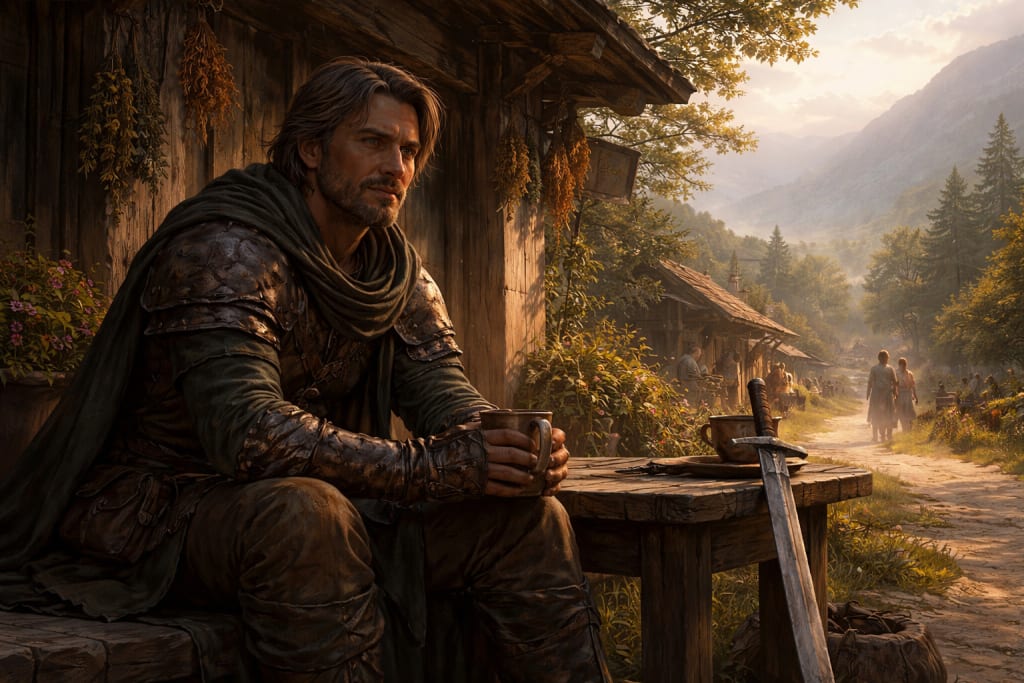
The soldier did not know his name.
He knew this was not always the case. Somewhere in the architecture of his mind there existed a room where his name had once lived — a room he could locate by feel, the way you know where furniture stands in a dark house — but the room was empty now, swept clean, and had been for longer than he could calculate, because calculating required memory and memory was precisely what he was running out of.
What he had instead: the weight of a sword, so familiar in his hand that his fingers shaped themselves around an absent hilt while he slept. The specific geography of old wounds — a ridge of scar tissue along his left forearm, a deep ache in his right knee when rain was coming, a place at the back of his skull where something had struck him with enough force to change the sound of his own thoughts. He had muscle memory, which was its own kind of knowing, below language and recollection, the body's private archive. His hands knew a hundred ways to keep him alive.
He knew less and less about why he wanted to be.
The curse had been explained to him once, by someone whose face he no longer held. He had written the explanation down — had been clever enough, in whatever early stage of the curse this was, to understand that cleverness would be necessary — and he carried the written account in a leather pouch worn smooth against his chest. He read it every morning, the same way a man with a wound checks the bandage: not expecting it to be gone, but needing to confirm the state of it.
The God of War has laid upon you the following condition, the note read, in handwriting that was his own but felt like a stranger's. For each victory in battle — each enemy defeated, each conflict resolved by your sword — you will surrender one memory to him. The memories do not return. The god does not specify which memories will be taken. They are simply gone when the battle ends, as cleanly as a flame extinguished. You will continue to fight because you are very good at fighting and because the world will keep presenting you with situations that require it. This is the trap. You have been a warrior too long to be anything else, and the god is patient.
At the bottom of this note, his past self had added, with what the soldier recognized as a characteristic pragmatism that he apparently retained even in crisis, is the name of the person you must find. She is the only one who knows how to end this. Find her before there is nothing left of you worth saving.
At the bottom of the note was a name.
Seraphine of the Unmade Road.
Beneath it, in smaller letters, underlined twice with enough force to indent the leather beneath the parchment:
She knew you before all of this. She will know if you are still you. Trust what she says, even if it hurts. Especially if it hurts.
He traveled under no name. People he met along the road called him what they liked — wanderer, soldier, scar-face, the quiet man — and he answered to all of these with equal indifference, because none of them were wrong and none of them were right.
The road was long. The world, he had gathered from his notes, was in one of its periodic states of conflict — kingdoms pressing against kingdoms, old grievances finding fresh reasons to bleed, every valley and crossroads apparently in dispute. This meant that the road presented him, with tedious regularity, with situations requiring a sword.
He was trying very hard not to use it.
His notes documented this effort with the honest precision of a man reporting on someone he was watching from a slight distance: I chose the long way around the garrison. I spent money I don't have to avoid a toll dispute that was becoming violent. I left an inn when the argument in the corner looked like it was heading somewhere I would be expected to intervene. The notes also documented his failures: seven engagements in what appeared to be, based on dates recorded in the margins, the last four months. Seven memories gone.
He could no longer remember what his mother looked like. He had deduced this from absence — from reaching for the image and finding the room empty — rather than from any direct knowledge of the loss. He could not remember the name of the city where he was born, or the face of the first person he had loved, or what he had wanted to be before wanting had been replaced by war. He could remember tactics, blade angles, the weak points of fourteen different types of armor, the way fear smells on an enemy in the moment before the outcome becomes clear.
He remembered everything useful for destroying things.
He was forgetting everything that made destruction worth grieving.
He found her in a town that had no name on any map he carried, at the end of a road that the locals called the Unmade Road, which was explanation enough.
She was sitting outside a building that was part inn and part something else — the walls hung with objects he didn't have the context to interpret, bundles of dried things, small mirrors, strings of symbols in a script that wasn't any language he recognized. She was perhaps sixty years old, with the unhurried quality of someone who has stopped measuring time against the usual benchmarks. She was mending a piece of cloth and she did not look up when he stopped in front of her, though he had the clear impression that she had known he was coming for longer than he had known he was going.
"Sit down," she said. "You look like a man who has been standing for years."
He sat. He produced the note from the pouch and held it out to her.
She glanced at it without taking it. "I know what it says."
"Did you write it?"
"No. You wrote it. I told you what to write." She set down her mending and looked at him directly for the first time, with an attention so complete and so unhurried that it felt, oddly, like being read. "How much is left?"
He considered the question with the honesty it deserved. "I don't know. I know things are missing. I can feel the shape of what's gone. It's like—" he paused, looking for the right comparison, "—like a library where someone has removed books but left the shelves. The shelves are still there. They're just empty."
Seraphine nodded slowly. "Your name," she said. "Do you know it?"
"No."
"Your wife's name."
A pause. A reaching into the empty room. "No."
"Your daughter's face."
The soldier was quiet for a long moment. Something moved across his expression — not quite pain, because pain required the memory of what had been lost, and that was exactly what was gone, but the echo of it, the acoustic shadow of a grief without its object.
"No," he said.
Seraphine looked at him with an expression that was not pity — pity required distance and she was not distant — but something closer to the way a surgeon looks at a wound they have seen before and know how to treat. "You have a daughter," she said. "She is eleven years old. Her name is Mira. She has your eyes and her mother's stubbornness and she has been waiting for you for three years. I want you to understand that before we discuss what comes next, because what comes next is difficult and you need to know what you're doing it for."
The soldier absorbed this. He could not remember Mira's face. He could not remember her eyes, or her mother's stubbornness, or three years of waiting made concrete in a child's particular way — the checking of roads, the conversations with a father who wasn't there. But he believed Seraphine. His own note had told him to, and whatever self had written that note had known him better than he currently knew himself.
"What comes next," he said.
"The god will offer you one final battle," Seraphine said. "This is how the curse ends — not by avoiding it but by completing it. One last fight, of his choosing, and if you win, the curse lifts. You keep what's left and you go home."
"And if I lose?"
"You forget everything. Not gradually — all at once. You become a sword with no one behind it." She said this plainly, without softening. "But that's not the part that should concern you."
"What should concern me?"
"The battle he's chosen," Seraphine said, and picked up her mending again, "is not with an enemy. It's with yourself. With what you've become. The god doesn't want your memories, ultimately. He wants your willingness to keep trading them away. He wants to prove that a warrior will always choose the fight over the cost of the fight." She pulled a stitch through the cloth. "He's been right, so far, about most warriors. The question is whether he's right about you."
The god appeared at midnight.
Not with thunder or transformation or any of the theatrical apparatus that the soldier had half expected from a deity announcing a final reckoning. He simply sat down across the fire from him — a figure that was large in a way that had nothing to do with physical dimension, wearing the face of no one specific and somehow the face of everyone who had ever sent men to die for reasons that looked better on a map than in a field.
"One last fight," the god said. He had the pleasant, neutral voice of someone announcing the weather.
"I know," the soldier said.
"You have won every battle you've ever fought," the god said. It was not quite admiration. It was the assessment of someone whose interests are served by this fact. "You are very good at war."
"I know that too."
"The battle I'm offering you is with yourself," the god said. "Specifically, with the part of yourself that defines victory as survival and defeat as death. The part that has traded everything you love for the ability to keep living. The part that will, if given the chance, win this fight and trade one more memory for the privilege." He paused. "I want you to fight that part and lose."
The soldier looked at the fire for a while.
"You want me to lose," he said.
"I want you to understand that losing is sometimes the only way to win." The god's voice had something in it that might, in a human, have been called patience, but in a deity felt more like the satisfaction of a trap closing. "Stop fighting. Put down the sword. Accept the defeat. See what remains."
The soldier understood then — with a clarity that felt like the first truly clear thing he had known in months — that this was the trap's final form. Not the battles on the road, not the accumulating losses, but this: a god of war, offering peace as the terms of surrender, counting on a lifetime of fighting to make peace feel like defeat, counting on pride to make the soldier refuse the one move that would actually save him.
He thought about Mira's face that he could not remember.
He thought about the empty rooms in his mind, and the shelves with no books, and the note written in his own hand by a man who had known enough to write it down before the knowing was taken.
He put down the sword.
Not dramatically. Not as a gesture. He simply set it on the ground beside him and looked at the god with the steady, unperformed calm of a man who has done the hardest arithmetic of his life and arrived at the right answer.
"I surrender," he said.
The god looked at him for a long moment.
Then something shifted in the figure across the fire — a contraction, a diminishment, the specific deflation of a certainty confronted with its exception.
"That wasn't supposed to be possible," the god said, quietly.
"I know," the soldier said. "I'm an accountant about it."
The memories did not return all at once. They came back slowly, the way circulation returns to a numbed limb — first the awareness of absence, then a tingling, then fragments, then the overwhelming specificity of things reclaimed: his name, which was Aldric; his wife, who was called Nora and who laughed at her own jokes before she finished telling them; the face of his daughter, which was, as Seraphine had said, his eyes set into an expression of absolute and weaponized patience that was entirely her mother's.
He sat by the dead fire until morning, remembering.
When the sun came up, he found Seraphine at her table outside the unnamed inn, mending the same cloth or a different one.
"Well," she said, without looking up.
"Well," he said.
"Mira is in the village of Caranthe," she said. "Two days east. She will be angry with you for a while. You should let her."
"I know," Aldric said.
He picked up his sword from where he had left it. He looked at it for a moment — at the familiar worn grip, the nicks along the blade that were a history he could now almost fully read. Then he set it down on Seraphine's table.
"I don't think I'll need this anymore," he said.
Seraphine looked at the sword. She looked at him. She permitted herself a small, private smile of the kind that belongs to people who have waited a long time for a specific thing to happen and have not let themselves be certain it would.
"Go home, Aldric," she said.
He went east, into the morning, carrying nothing but his name and everything he had nearly lost, and the road ahead of him was, for the first time in longer than he could previously remember, completely, quietly, ordinary.
It was the best thing he had ever won.
From the border records of Caranthe Village, season of the late harvest:
One man, arrived on foot, no weapons, no stated business. Name given: Aldric. Purpose of visit: "My daughter is here." Admitted without question.
About the Creator
Cordelia Vance
Lost in the ink-stained corridors of a life lived through pages. I write to capture the whispers of ghosts we pretend not to hear and the shadows we call home. Welcome to my attic of unspoken truths.
Keep reading
More stories from Cordelia Vance and writers in Fiction and other communities.
The Man Who Couldn't Boil Water
Carlo Benedetti had exactly three culinary skills. He could boil water — usually. He could open a can of tomatoes without injuring himself — mostly. And he could, when the circumstances were sufficiently desperate, produce a plate of scrambled eggs that was edible in the same way that a Tuesday afternoon in February is technically a day: technically correct, bringing no one any particular joy.
By Cordelia Vanceabout 7 hours ago in Fiction
Parting is such sweet and salty sorrow...
Dear Wife— At first, I hesitated to go forward with this resolution. But after your recent late-night binges scarfing down bags of chicharrónes—those pork rinds you dip in butter and the god-awful crunch they make, I knew I could no longer reach you.
By Lamar Wiggins6 days ago in Fiction



Comments
There are no comments for this story
Be the first to respond and start the conversation.