
The Moment Empires Stop Following the Rules
The Hidden Reason Empires Collapse

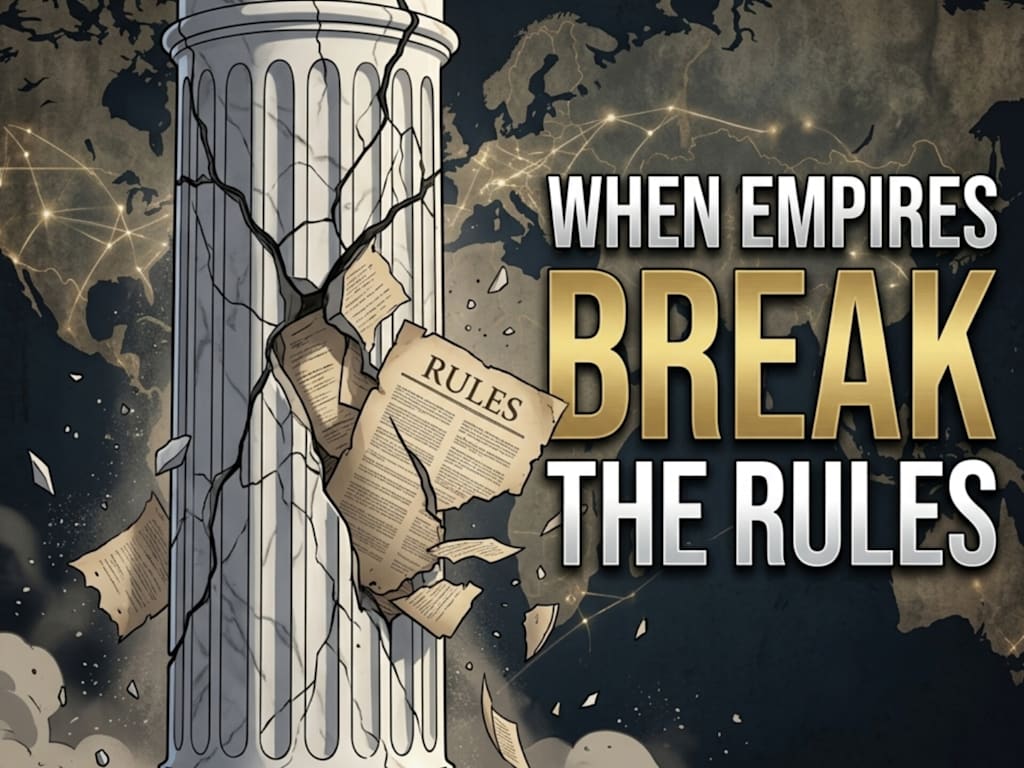
The empire had lasted for more than three hundred years.
People in the capital liked to say it was eternal. Children learned its history in school. Old men in tea houses repeated the same line again and again: empires survive because they follow rules.
There were rules for kings. Rules for soldiers. Rules for judges. Rules for trade. Rules for war.
That was what separated the empire from the tribes beyond the mountains and the kingdoms across the sea.
At least, that was what everyone believed.
Elias had spent most of his life inside the royal archive, copying old letters and recording taxes from distant provinces. He was not an important man. Nobody noticed him. Nobody remembered his face.
That was why he saw things others did not.
Every morning, sealed documents arrived from the palace. Elias and the other scribes sorted them into shelves.
One winter morning, a letter arrived with the royal seal.
It was a report from the northern province.
A governor had refused to pay taxes because a drought had destroyed the farms. According to imperial law, the governor should have been questioned by a court.
Instead, the emperor ordered the governor’s entire family executed.
Elias read the order twice.
Then a third time.
He thought perhaps it had been written by mistake.
But the next week, another letter came.
A city in the east had protested against rising prices. Imperial law said soldiers could only enter a city if local leaders requested help.
The emperor ignored the law.
Five thousand soldiers entered the city.
Hundreds of people disappeared.
The official report called it a peaceful operation.
By spring, the old rules had become meaningless.
Merchants could be arrested without trial. Land could be taken without compensation. Judges who disagreed with palace orders simply vanished.
At first, people stayed silent.
They told themselves the empire was only going through a difficult season.
“Things will return to normal,” they whispered.
But nothing returned to normal.
One evening, Elias visited his friend Adrian, who had once served as a military officer.
Adrian lived in a small house near the river. He poured tea into two cups and listened quietly as Elias described the letters.
When Elias finished, Adrian stared out the window.
“Do you know what holds an empire together?” Adrian asked.
“The army?” Elias said.
Adrian shook his head.
“Belief.”
He pointed toward the city outside.
“People obey because they think the system is fair. Soldiers fight because they think the law matters. Judges judge because they think someone above them still respects the rules.”
He looked back at Elias.
“The moment rulers stop following their own laws, the empire starts dying. Maybe slowly. Maybe quietly. But it starts dying.”
Elias wanted to disagree.
He wanted to believe that great walls, strong armies, and gold-filled treasuries were enough.
But deep down, he knew Adrian was right.
The summer brought food shortages.
The emperor blamed traders and had several of them publicly executed.
Then he blamed local officials.
Then foreign spies.
Each week, new enemies appeared.
Fear spread across the empire.
People stopped trusting neighbors. Shopkeepers hid their money. Families spoke in whispers behind closed doors.
Even soldiers no longer trusted their commanders.
In the south, an army captain refused an order to burn a village.
He and his men were killed.
After that, more soldiers deserted.
Some joined rebel groups in the hills.
Others simply went home.
The empire still looked strong from the outside.
Its flags still waved above government buildings.
Its coins were still used in markets.
Its armies still marched through the streets.
But inside, everything was rotting.
Elias saw it clearly in the archive.
The shelves were full of reports about missing grain, unpaid soldiers, angry villages, and broken roads.
Every province was sending warnings.
Nobody in the palace listened.
Then, one autumn morning, the bells of the capital began ringing.
Crowds gathered in the streets.
Smoke rose near the palace walls.
A group of soldiers had turned against the emperor.
Other soldiers joined them.
By sunset, the palace gates had fallen.
The emperor disappeared.
Some said he escaped through a secret tunnel.
Others said his own guards killed him.
No one ever learned the truth.
That night, Elias stood outside the archive and watched flames rise into the dark sky.
The empire that had seemed eternal was collapsing in front of him.
Not because of foreign invasion.
Not because of famine.
Not because of weak armies.
It collapsed because the people at the top stopped obeying the rules they expected everyone else to follow.
And once that happened, the empire was already broken.
It simply took time for the rest of the world to notice.
About the Creator
Keep reading
More stories from JAMES NECK and writers in Fiction and other communities.
The Lighthouse Ending Explained
The Lighthouse is one of those rare horror movies that stays in your head long after the credits roll. It is disturbing, mysterious, and completely open to interpretation. The film follows two lighthouse keepers trapped on a remote island, cut off from the rest of the world. As the days drag on and the weather becomes worse, the isolation slowly destroys both men mentally.
By JAMES NECK 2 days ago in Humor
Ra'ad Does Not Dwell in Time
Ra'ad Does Not Dwell in Time By luccian layth Here collapses a corner of events — purely narrative, risen from the drain of our old house's gutter, seeping into the channels of a despondent city. Dark of atmosphere. Wretched to look upon. Like an old grey woman the ages have ruined, her sides ulcerated, spoiled like dried apple where worms have long since finished their work and moved on to something equally forgettable.
By LUCCIAN LAYTH2 days ago in Fiction
Something Is Beginning, I Think Challenge Winners
This challenge wasn’t about clean starts. It was about that weird in-between where something is beginning, but no one really knows what yet. A lot of these stories leaned into hesitation, into pauses and false starts and that feeling that something is about to happen but hasn’t quite.
By Vocal Curation Teama day ago in Resources


Comments
There are no comments for this story
Be the first to respond and start the conversation.