
Last Seat Left Open
A quiet story about the rules we follow, and the ones that follow us.

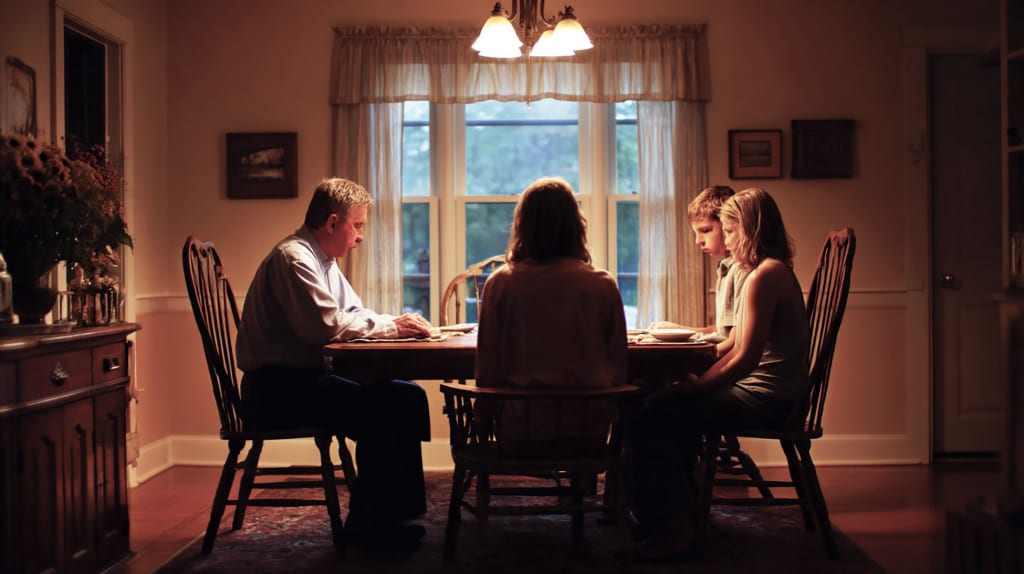
The first time Daniel noticed it, he thought it was a mistake.
Five chairs. Four people.
His mother moved between the stove and the table, setting plates down in her usual rhythm. His father sat at the far end, already eating, eyes lowered. His sister swung her legs, waiting.
And then there was the last place.
A plate. A glass, half full. A folded napkin.
No one sat there.
Daniel reached for the bread.
“Don’t,” his mother said, not looking at him.
His hand stopped midair.
“That one isn’t yours.”
He pulled back slowly, unsure what rule he’d broken—only that he had.
No one explained it.
Dinner went on.
At some point, as his father reached for his glass and his sister asked for more bread, Daniel felt it—
a faint shift of air beside him.
Not a draft. Not the movement of anyone passing.
Just the slightest change, as though someone had leaned forward from that last place at the table.
He glanced up, almost without thinking.
The chair was empty.
And yet, for a moment, he had the strange sense
that he’d interrupted something.
It wasn’t just at home.
At school, the long cafeteria tables always seemed to end with an empty seat. Not always the same one, not always in the same place—but always there. A tray. A carton of milk. Sometimes utensils, still wrapped.
When the new boy tried to sit, someone touched his arm.
“Not that one.”
He laughed, thinking it was a joke. No one else did.
He moved.
The seat remained.
Daniel learned the way everyone learned.
You watched. You followed. You noticed what people did—and what they didn’t.
You didn’t take the last seat.
You didn’t move what had been placed there.
And you didn’t ask.
Years passed.
The empty seat settled into the background of things, like the hum of the refrigerator or wind pressing softly at the windows. It was always there, and because it was always there, it didn’t need explaining.
Until it did.
His grandmother changed it.
She arrived with her quiet way of watching, taking things in as if she were measuring something no one else could see.
On her second evening, she set the table.
Daniel noticed before anyone said a word.
Four plates.
Four glasses.
Four napkins.
No fifth.
“Grandma,” he said.
She turned, calm. “Yes?”
“You forgot one.”
She followed his gaze, then looked back at him.
“No,” she said. “I didn’t.”
Something in the room shifted.
His mother entered, slowed, took in the table.
“Mom,” she said softly.
His grandmother met her eyes. “There are four of us.”
Silence held for a beat too long.
Then his mother crossed to the cupboard. Took down the plate. The glass. The napkin.
Set them in place with care.
“There,” she said.
His grandmother watched, then sat.
Dinner began.
No one spoke of it.
That night, Daniel couldn’t sleep.
The house was never completely still. Wood settling. Air moving through unseen spaces. A distant car passing.
He thought about the table.
About the way his mother hadn’t hesitated—hadn’t questioned—only corrected.
As if the missing place had been something real.
He tried to remember when it had started.
He couldn’t.
In the morning, his grandmother sat by the window with her tea, watching the light come in.
“You noticed,” she said.
It wasn’t a question.
“Yes.”
“And no one told you why.”
“No.”
She nodded.
“They wouldn’t.”
“Why not?”
She looked at him, steady.
“Because it works better this way.”
“What works?”
A faint smile.
“You’ll see.”
At school, he started noticing more.
The empty seat wasn’t ignored—it was accounted for.
A teacher rearranged groups before anyone had to take it.
A library table held five when it could hold six.
In the auditorium, rows filled unevenly, leaving one space at the end.
No one said anything.
They didn’t have to.
The closest he came to breaking it was by accident.
He arrived late to a meeting. Chairs formed a loose circle. All but one were taken.
He moved toward the last seat.
“Daniel.”
Mr. Alvarez stood behind him.
“That one’s taken.”
Daniel looked at the chair.
Empty.
“By who?”
Mr. Alvarez didn’t answer. Just guided him away.
“We’ll make space.”
Another chair appeared. The circle shifted.
The empty one stayed where it was.
Untouched.
That night, Daniel set the table.
Plate. Glass. Napkin.
Four times.
Then he stopped.
The cupboard was still open.
The fifth plate within reach.
The house was quiet. The clock ticking. Voices low in the next room.
You’ll see.
He reached for it.
His mother paused in the doorway.
Looked at the table. Then at him.
Neither spoke.
But something passed between them.
Not surprise.
Not approval.
Recognition.
She stepped forward, smoothed the napkin at the last place.
“Thank you,” she said.
Dinner was quieter than usual.
Daniel felt the empty seat differently now—not as a gap, but as something shaping everything around it.
His father never looked at it.
His sister didn’t notice.
But his mother—once—let her eyes rest there.
Just once.
Later, the table was cleared.
Chairs pushed in.
Except one.
The last seat sat slightly back, as though someone had just stood and left.
Daniel stepped closer.
He could push it in. Make it even. Close the space.
His hand rested on the chair.
The wood was smooth. Worn.
He looked at the table.
At the space where the plate had been.
At what remained of it.
Then he let go.
Left it as it was.
His grandmother was gone the next morning.
Left early, his mother said. Didn’t want a fuss.
That felt right.
At breakfast, there were four again.
His father.
His sister.
His mother.
And the last place, set as always.
Daniel sat.
Reached for his cup.
And without meaning to, glanced at the empty chair.
Something in him settled.
Not fear.
Not curiosity.
Something quieter.
He never asked.
And after a while, he stopped wondering.
Because some things weren’t meant to be explained.
Only kept.
And once—just once, as the morning light shifted across the table—
he had the distinct feeling
that the last seat
was no longer empty.
About the Creator
Rick Allen
Rick Allen reinvented himself not once, but twice. His work explores stillness, transformation, and the quiet beauty found in paying close attention.
Keep reading
More stories from Rick Allen and writers in Fiction and other communities.
The Archivist's Room
Miriam Hale had learned to measure time by the way dust settled. It drifted through the shafts of desert light that crossed the library’s high windows, bright as river water at noon. In the stillness before opening, she walked the aisles, touching spines as if greeting neighbors. Forty years in this small-town library had taught her the weight of silence and the comfort of routine.
By Rick Allen5 months ago in Fiction
Waiting
It could have been the perfect summer day. The hot July sun warmed the water in the backyard pool just enough to be comfortable and refreshing. The laughter of the five little girls echoed against the splashing water as they chased each other in a classic game of Marco Polo. The game distracted them enough that they failed to notice the dipping sun nearing the horizon. Their fingers and toes had long ago turned wrinkly like raisins, but none wondered why they had been left to play so long today.
By A. J. Schoenfeld8 days ago in Fiction
The Rearview Mirror of the Soul
The Rearview Mirror of the Soul The gold-leafed journal on Maya’s nightstand was a collection of lies she desperately wanted to believe. “I am a magnet for abundance,” she had written that morning, her pen carving the words into the paper with a force that betrayed her exhaustion. But as she stepped out into the humid gray of a Los Angeles morning, the "abundance" she felt was a heavy, suffocating anxiety.
By Fatima Smith2 days ago in Fiction


Comments
There are no comments for this story
Be the first to respond and start the conversation.