
How to Choose Between Microsoft Azure, Amazon Web Services, and Google Cloud Platform for Legacy Application Migration
A Practical Guide for Choosing Cloud Providers (AWS, Azure, and GCP) for Legacy Application Migration

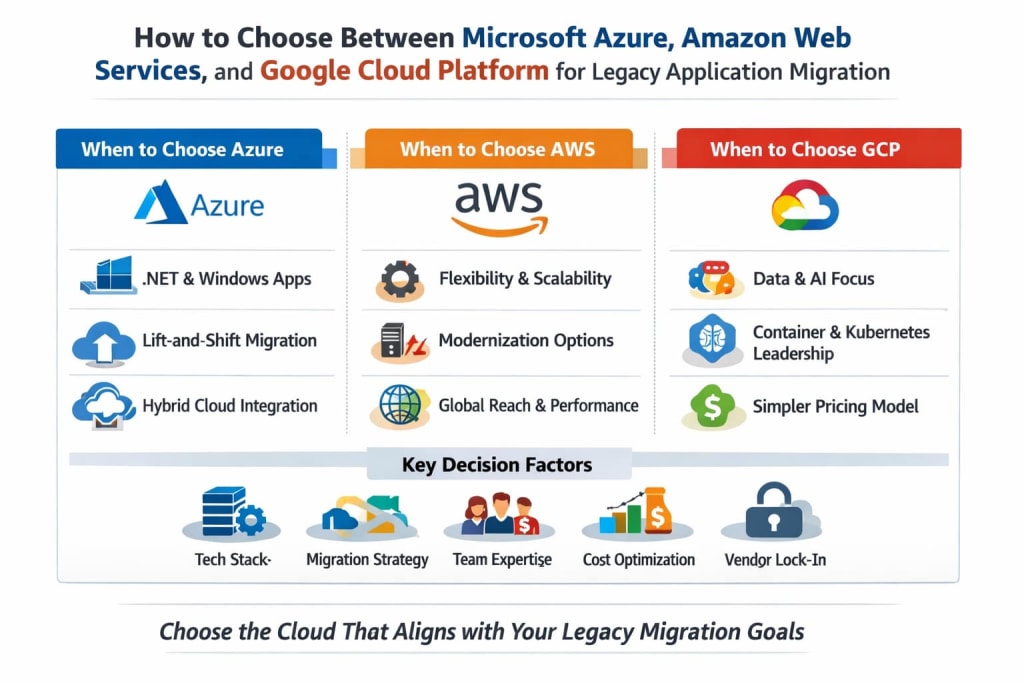
Migrating legacy applications to the cloud is no longer optional for most organizations—it is a prerequisite for scalability, resilience, and long-term cost efficiency. However, one of the most important and often underestimated decisions is selecting the right cloud provider.
While Azure, AWS, and Google Cloud Platform (GCP) all offer robust capabilities, they are not interchangeable. Each platform has strengths that align better with specific legacy environments, migration strategies, and business goals.
This article provides a practical, decision-focused framework to help you choose the right cloud provider for legacy application migration—without unnecessary complexity.
Understand Your Legacy Application First
Before comparing providers, you need to define what you are migrating. “Legacy application” is a broad term and can include:
- Monolithic enterprise systems
- Applications built on outdated frameworks
- On-premises databases with tight coupling
- Systems dependent on specific OS or hardware
The migration approach typically falls into one of these categories:
- Rehosting (lift-and-shift): Move as-is with minimal changes
- Replatforming: Make small optimizations without changing architecture
- Refactoring: Redesign into cloud-native architecture
Your choice of cloud provider should align with this strategy.
When Microsoft Azure Is the Best Choice
Azure is often the strongest option for organizations deeply embedded in the Microsoft ecosystem.
Seamless Microsoft Stack Integration
If your legacy system relies on:
- .NET Framework
- Windows Server
- Active Directory
- Microsoft SQL Server
Azure provides the most natural migration path. The compatibility is high, and the need for reconfiguration is minimal.
Faster Lift-and-Shift Migrations
Azure simplifies rehosting:
- Native support for Windows-based virtual machines
- Familiar tools for IT teams
- Smooth identity and access migration
This reduces both migration time and operational risk.
Hybrid and Enterprise Readiness
Azure is particularly strong in hybrid scenarios where part of your infrastructure remains on-premises. This allows gradual migration rather than a full transition.
It also integrates well with existing enterprise agreements, which can simplify procurement and reduce licensing costs.
Limitations to Consider
Azure may not be the best option if:
- You plan to aggressively move toward cloud-native architectures
- Your workloads are primarily Linux or open-source based
- You require highly granular infrastructure control
When Amazon Web Services Is the Right Fit
AWS is the most mature cloud provider and offers the broadest set of services, making it suitable for complex and large-scale migrations.
Maximum Flexibility
AWS supports all migration strategies effectively:
- Rehosting via virtual machines
- Replatforming using managed services
- Refactoring into microservices or serverless architectures
This flexibility is crucial if your migration roadmap includes modernization over time.
Extensive Service Ecosystem
AWS provides a wide range of tools for:
- Compute and storage
- Database migration
- Networking and security
This is particularly useful for legacy systems with unique or non-standard requirements.
Global Infrastructure and Reliability
AWS has the largest global footprint, which benefits:
- International applications
- High-availability systems
- Performance-sensitive workloads
Limitations to Consider
- The platform can be complex for teams without prior AWS experience
- Pricing models require careful management to avoid cost overruns
- Less native optimization for Microsoft-heavy environments compared to Azure
When Google Cloud Platform Makes Sense
GCP is often overlooked but can be the best choice in data-driven and modernized migration scenarios.
Strong Focus on Data and Analytics
If your migration includes:
- Data warehouse modernization
- Real-time analytics
- Machine learning integration
GCP offers powerful and well-integrated solutions.
Best-in-Class Kubernetes and Containers
If you are refactoring your legacy system into microservices, GCP stands out due to its leadership in Kubernetes.
It provides a more streamlined and developer-friendly environment for containerized workloads.
Transparent and Predictable Pricing
Compared to AWS, GCP pricing is generally easier to understand and optimize, making it attractive for cost-conscious organizations.
Limitations to Consider
- Smaller enterprise ecosystem compared to AWS and Azure
- Less alignment with traditional Microsoft-based systems
- Fewer legacy-specific migration tools
Key Decision Factors That Actually Matter
Instead of focusing on brand preference, evaluate cloud providers based on these practical criteria.
1. Technology Stack Compatibility
This is often the most decisive factor:
- Microsoft-heavy → Azure
- Mixed or custom stack → AWS
- Cloud-native or container-focused → GCP
Choosing a provider aligned with your stack reduces migration complexity significantly.
2. Migration Strategy
Your approach influences the best platform:
- Lift-and-shift: Azure or AWS
- Gradual modernization: AWS
- Full refactoring: GCP or AWS
If speed is your priority, Azure often provides the least friction. If transformation is the goal, AWS and GCP offer more flexibility.
3. Team Expertise
Skills matter more than features.
- Existing Microsoft expertise → Azure
- Experience with diverse cloud tools → AWS
- Strong DevOps and container skills → GCP
Training costs and learning curve should not be underestimated.
4. Cost Structure and Optimization
Each provider has a different pricing philosophy:
Azure: favorable for existing Microsoft customers
AWS: highly flexible but complex pricing
GCP: simpler and more predictable pricing
Cloud cost optimization strategy by migration of outdated systems depends heavily on how well your team understands the platform.
5. Long-Term Architecture Goals
Think beyond migration.
- If you plan to keep legacy architecture → Azure
- If you plan gradual modernization → AWS
- If you aim for cloud-native transformation → GCP
Choosing a provider that aligns with your future state avoids rework later.
6. Vendor Lock-In Risk
Each cloud provider offers proprietary services that can increase dependency.
- AWS: widest range of proprietary tools
- Azure: strong integration within Microsoft ecosystem
- GCP: more open-source alignment, especially with Kubernetes
If avoiding lock-in is a priority, favor open standards and portable architectures.
Common Mistakes to Avoid
Choosing Based on Popularity
The “market leader” is not always the best fit. Your internal systems and goals matter more than market share.
Ignoring Migration Complexity
Underestimating the effort required to adapt legacy systems leads to delays and budget overruns.
Overlooking Operational Costs
Cloud costs do not end after migration. Poor architecture decisions can significantly increase long-term expenses.
Skipping a Proof of Concept
Testing migration scenarios on a small scale can reveal hidden challenges before full commitment.
A Practical Decision Framework
To simplify your decision, use this quick guideline:
- Choose Azure if your legacy system is tightly coupled with Microsoft technologies and you want a smooth, low-risk migration.
- Choose AWS if you need flexibility, scalability, and a long-term modernization path.
- Choose GCP if your focus is on data, containers, and building a modern cloud-native architecture.
In many real-world cases, a multi-cloud or hybrid approach may also be worth considering, especially for large enterprises.
Final Thoughts
There is no universally “best” cloud provider for legacy application migration. The right choice depends on your existing architecture, team expertise, migration goals, and long-term strategy. Azure minimizes friction for Microsoft-based systems. AWS offers unmatched flexibility and ecosystem depth. GCP provides a strong foundation for modern, data-driven applications. The key is to align your cloud choice for the migration of legacy systems to the cloud not just with where your application is today—but where you want it to be in the future.
About the Creator
Chudovo
Chudovo is a custom software development company, focused on complex systems implementation.
Sky-High Ambitions: Top 10 Best Colleges For BBA Aviation in India 2026
If you’ve spent any time at an airport lately, you’ve seen the chaos. Huge crowds, massive new terminals, and more planes than ever before. India’s aviation sector isn’t just growing; it’s exploding. But behind every smooth takeoff is a massive team of managers making sure the gears turn. That’s where a BBA in Aviation comes in.
By Johan Olers4 days ago in Education
How Bhakti Rasamrita Sindhu Defines Krishna Consciousness
Bhakti Rasamrita Sindhu and the Foundations of Krishna Consciousness The spiritual landscape of India has gifted humanity with countless texts, but few have influenced devotional practice as deeply as Bhakti Rasamrita Sindhu. For anyone seeking a profound understanding of Krishna devotion, this sacred work serves as a timeless compass. Within the first steps of exploring this tradition, one naturally encounters a comprehensive Guide to Bhakti Rasamrita Sindhu, which unveils the systematic path of bhakti, or loving devotional service, in its purest form.
By sudeshna rarhi6 days ago in Education
March 15, 2026
Merriam Webster - Word of the day: Tranche refers to a division or portion of a whole. World Contact Day is commemorated every year on March 15. It is a unique observance held globally to focus on communicating with extraterrestrial life and exploring the possibility that intelligent beings may exist beyond Earth. World Contact Day inspires people to invoke their curiosity and spend time thinking about the universe and the mysteries surrounding it. What is the “Ides of March”? According to the Roman calendar, the Ides are a monthly occurrence. In March and other months with 31 days, the Ides always falls on the 15th; it falls on the 13th in months with 30 days. The Ides traditionally marked the arrival of the new Moon and was cause for celebration. The word “Ides” is derived from Latin, meaning “to divide.” Mothering Sunday in 2026 falls on Sunday, March 15. Mothering Sunday, celebrated in the United Kingdom and Ireland, occurs on the fourth Sunday of Lent, which is exactly three weeks before Easter. Unlike the fixed-date Mother's Day in countries like the United States, Canada, and Australia, Mothering Sunday’s date changes each year according to the Christian liturgical calendar. On March 15, 2026, several notable observances and events are celebrated: Dumbstruck Day: A day to express frustration. Everything You Think is Wrong Day: A day to challenge and celebrate wrong beliefs. International Day Against Police Brutality: A day to raise awareness and advocate against police violence. My look at today, March 15, 2026 below:
By Denise E Lindquist8 days ago in Writers




Comments
There are no comments for this story
Be the first to respond and start the conversation.