

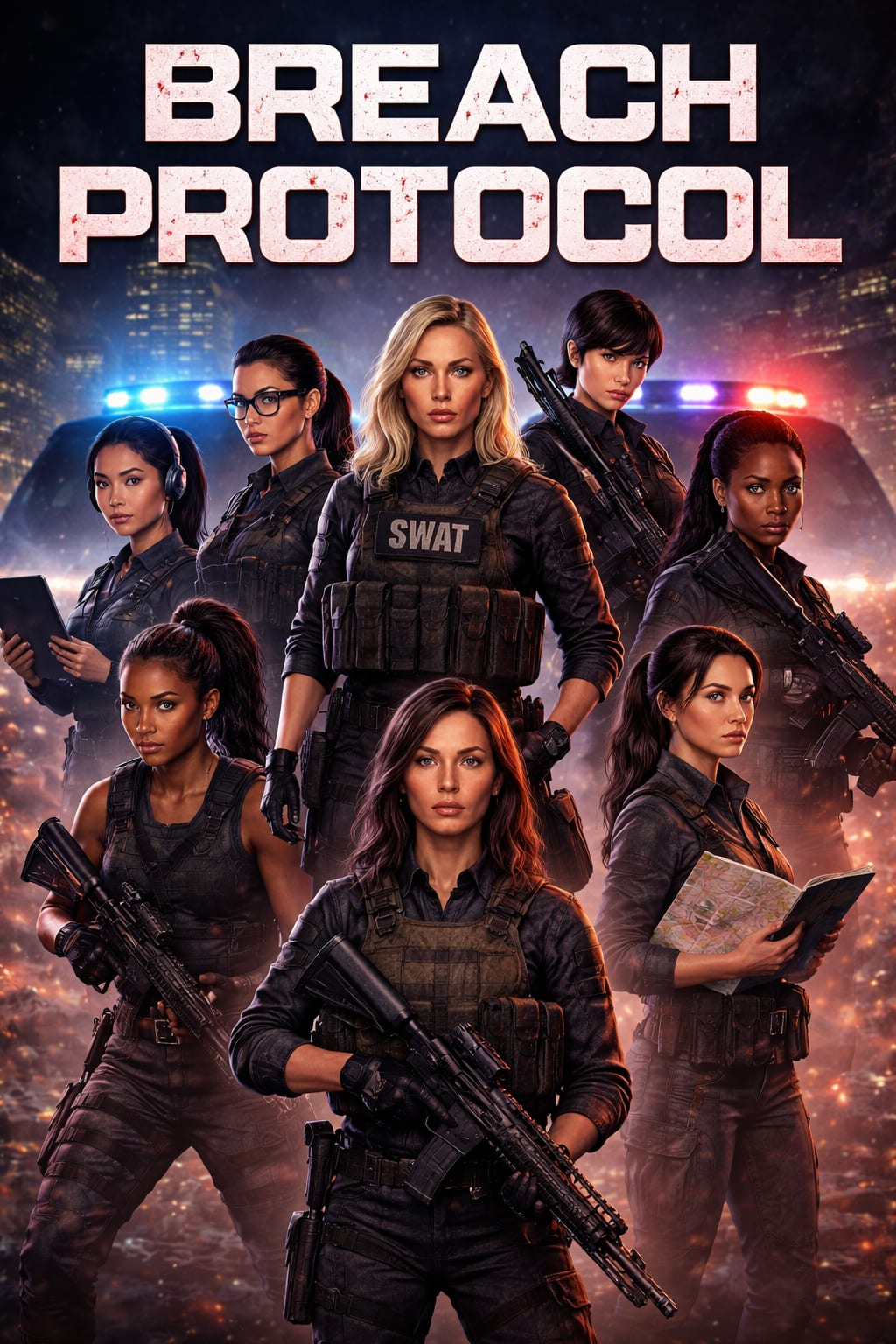
Breach Protocol – Part 1: Formation
They didn’t announce the program.
No press conference. No internal memo blasted across departments. No polished language about innovation, progress, or inclusion.
Because if it failed—and most of them expected it would—there would be no paper trail tying anyone important to it.
Captain Rhea Vaughn preferred it that way.
Less noise. Less politics. More control.
She stood alone in Observation Room 3B, the lights dimmed low enough to make the footage on screen feel sharper than it really was. The glow from the monitor painted her face in pale blues and hard shadows, catching the stillness in her eyes.
Timestamp: 02:14.
The moment everything shifted.
A man paced across a cluttered living room, barefoot, shirt damp with sweat. His grip on the gun wasn’t steady—it trembled just enough to matter. Not trained. Not disciplined. Emotional.
Dangerous in a different way.
Behind him, a woman sat on the floor, wrists bound, tears streaking down her face. She wasn’t screaming anymore.
That was the detail that mattered.
People stopped screaming when they lost hope.
Rhea leaned forward slightly, elbows resting on her knees.
Outside the apartment door, the entry team stacked up. Heavy boots. Thick vests. Weapons ready.
One of them raised a fist.
“Three… two—”
Rhea paused the footage.
There.
Every time, it was there.
The decision.
The assumption.
The mistake.
They had already decided how it would end.
She rewound it. Played it again.
“Three… two—”
Pause.
Again.
The man’s pacing changed just slightly before the countdown ended. His shoulders tightened. His breathing hitched. Something in him shifted—but the team never saw it.
They weren’t looking.
They were executing.
And execution without awareness?
That’s how people died.
Rhea exhaled slowly, leaning back in her chair.
Seven times she’d watched it. Seven times it ended the same way.
Gunfire.
Screaming.
Blood.
Wrong.
“You planning to fix it, or just study it to death?”
The voice came from behind her, casual but edged with something sharper.
Rhea didn’t turn.
She already knew who it was.
Deputy Chief Malcolm Briggs.
He walked into the room like he owned every inch of it, hands tucked into his coat pockets, gaze flicking from the paused screen to her without much interest. He wasn’t here for the footage.
He was here for results.
“Fix it,” Rhea said evenly.
Briggs let out a quiet breath through his nose, unimpressed. “That’s what they all say.”
She finally turned her head, just enough to meet his eyes.
“With a team that doesn’t make that mistake twice.”
That got his attention.
Not much—but enough.
He stepped closer, folding his arms as he looked at the screen again. “You’re telling me the issue isn’t training.”
“I’m telling you the issue isn’t force.”
A beat.
“They’re trained to dominate,” Rhea continued. “Every scenario. Every variable. They go in assuming control solves everything.”
Briggs raised a brow. “And it doesn’t?”
“It escalates emotional subjects.”
She nodded toward the frozen image of the man on screen.
“That’s not a terrorist. That’s not a trained shooter. That’s someone unstable, overwhelmed, and reactive. You hit him with noise, pressure, aggression—he responds with chaos.”
“And your solution?”
Rhea didn’t hesitate.
“A team that knows when not to push.”
Briggs gave a short, humorless laugh. “You want softer operators?”
“No,” she said calmly. “I want smarter ones.”
Silence settled between them.
Measured.
Evaluating.
Briggs studied her for a long moment, like he was trying to decide whether this was brilliance or a liability.
“Alright,” he said finally. “Let’s say I entertain this.”
Rhea stood, straightening to her full height. She didn’t rush. Didn’t fill the silence. She let him come to her.
“You get one shot,” he continued. “Off the books. Limited oversight. You build your team, you run your op, and if it goes sideways—”
“It won’t.”
Briggs smirked slightly. “Confidence is expensive, Vaughn.”
“So is failure.”
Another beat.
Then he nodded once. Decision made.
“Pick your people,” he said. “But understand something—this isn’t a statement. This isn’t a movement.”
His tone hardened.
“This is a test.”
Rhea held his gaze.
“I don’t build tests,” she said quietly.
“I build outcomes.”
The first call didn’t go well.
It wasn’t supposed to.
Rhea stood in the doorway of a private boxing gym, arms crossed as she watched Keisha Owens dismantle a heavy bag like it had personally offended her.
The sound echoed through the space—thud, crack, thud—each hit controlled but violent.
Precision inside aggression.
Good.
K.O. moved like someone who understood impact. Not just how to deliver it—but when.
Rhea waited until the round ended.
Keisha ripped off her gloves, tossing them aside before grabbing a towel. She caught sight of Rhea in the mirror.
Didn’t turn around.
“Gym’s closed,” she said, voice steady but edged.
“I’m not here to work out.”
Keisha smirked faintly, still facing the mirror. “Then you’re definitely in the wrong place.”
Rhea stepped further in. “Keisha Owens.”
That got her.
She turned slowly, eyes scanning Rhea up and down. Assessing. Measuring.
“You got a badge or just a file?” she asked.
“Both.”
“Then you already know I don’t take meetings like this.”
Rhea didn’t move. “You also don’t walk away from something that matters.”
A flicker.
Small. Fast. But there.
Keisha grabbed a water bottle, taking a long drink before responding.
“Let me guess,” she said. “Special unit. High-risk ops. You need muscle.”
“I don’t need muscle,” Rhea said calmly.
“I need control under pressure.”
Keisha scoffed. “Same thing in your world.”
“No,” Rhea replied. “In my world, the difference decides who walks out alive.”
Silence.
Tension shifted.
Keisha stepped closer now, not aggressive—but not welcoming either.
“What’s the angle?” she asked. “Because this already sounds like politics.”
“It’s not.”
“It always is.”
Rhea met her gaze. Didn’t flinch.
“It’s a new unit,” she said. “Built differently. Operates differently.”
Keisha crossed her arms. “Different how?”
Rhea held the pause just long enough.
“Every member is a woman.”
That landed.
Not shock.
Not surprise.
Something more complicated.
Keisha let out a quiet breath, shaking her head slightly.
“Yeah,” she said. “That’s politics.”
“No,” Rhea said again. “That’s strategy.”
Keisha studied her for a long moment.
Then—
“You really believe that?” she asked.
Rhea didn’t hesitate.
“Yes.”
Another beat.
Then Keisha grabbed her gloves again.
“Good luck with that,” she said, turning away. “You’re gonna need it.”
Rejection.
Expected.
Rhea didn’t push.
She simply said, “First operation runs in five days.”
Keisha paused mid-step.
Rhea continued.
“Hostage situation. High emotional volatility. If you change your mind…”
She turned toward the door.
“I’ll be there whether you show up or not.”
And just like that—
she left.
Dr. Alina Cruz didn’t bother pretending to be impressed.
“You’re asking me to leave a stable position,” she said, flipping through the file Rhea had handed her, “for a unit that doesn’t officially exist.”
Her office was clean. Minimal. Controlled.
Just like her.
Rhea sat across from her, posture relaxed but deliberate.
“I’m asking you to be part of something that fixes what your current system can’t.”
Alina’s eyes lifted briefly.
Sharp.
“You don’t know what my system can do.”
“I know what it hasn’t done,” Rhea replied.
A flicker of irritation crossed Alina’s face.
Good.
Emotion meant engagement.
“You’ve lost three negotiations in the last eighteen months,” Rhea continued. “All high-risk. All emotionally unstable subjects.”
Alina closed the file slowly.
“That information is sealed.”
“Not entirely.”
Silence.
Heavy now.
Personal.
Alina leaned back slightly, studying her.
“You’re either very confident,” she said, “or very reckless.”
“Neither.”
“Then what?”
Rhea met her gaze.
“Precise.”
A long pause.
Then Alina exhaled softly, tapping the file against her palm.
“And what makes your team different?” she asked.
“They listen.”
Alina’s brow furrowed slightly.
“Everyone says that.”
“They don’t do it,” Rhea replied.
Another beat.
Then—
“You would’ve handled those negotiations differently,” Rhea added.
That hit.
Alina’s expression didn’t change—but something behind her eyes did.
“You don’t know that.”
“I do,” Rhea said quietly. “Because you already do.”
Silence stretched between them.
Then Alina leaned forward slightly.
“Five days?” she asked.
Rhea nodded.
Alina considered it.
Then—
“I’ll observe,” she said. “Nothing more.”
Rhea stood.
“That’s all I need.”
Sloane Mercer didn’t answer the door.
Which meant Rhea had to let herself in.
The place was quiet. Sparse. Intentional.
A rifle case sat open on the table.
Of course it did.
“I don’t like uninvited guests.”
The voice came from behind her.
Rhea didn’t turn immediately.
“I knocked,” she said.
“And I ignored it.”
Now she turned.
Sloane leaned against the doorway, arms crossed, expression unreadable.
“You should’ve taken the hint.”
Rhea stepped away from the table. “You left the service without filing a formal discharge explanation.”
Sloane smirked faintly. “You break into people’s homes often, or am I special?”
“You followed an order you knew was wrong.”
That wiped the smirk clean.
Silence.
Cold now.
Measured.
“You don’t know what I knew,” Sloane said.
“I know what you did after,” Rhea replied. “You stopped trusting command.”
A beat.
Then—
“I’m not offering you command,” Rhea added. “I’m offering you clarity.”
Sloane studied her.
Longer this time.
“Why me?” she asked.
“Because you see what others miss.”
Another pause.
Then Sloane glanced toward the rifle case.
“Five days,” Rhea said. “If you’re interested.”
She turned to leave.
“Don’t get killed before then,” Sloane muttered.
Rhea allowed herself the smallest hint of a smile.
“Not planning to.”
Harper Wells didn’t like surprises.
Which made the email sitting in her inbox particularly offensive.
Subject: Meeting Request – Immediate
From: R. Vaughn
No context. No briefing packet. No attachments.
Just a time and a location.
Harper stared at it for a full thirty seconds before opening it again—like more information might magically appear if she looked hard enough.
It didn’t.
Of course it didn’t.
She exhaled slowly, already irritated.
Unstructured requests meant unstructured people.
And unstructured people got others hurt.
Rhea found her in a city planning office three floors above street level, surrounded by maps, monitors, and enough data to build a small war.
Harper didn’t stand when she walked in.
Didn’t offer a handshake.
Didn’t pretend to be impressed.
“You’re missing half the information,” Harper said immediately, eyes still on her screen.
Rhea stepped closer.
“About what?”
Harper finally turned, expression sharp.
“Whatever this is,” she said, gesturing vaguely. “You don’t request a strategist without providing a framework.”
Rhea studied her.
Detail-oriented. Controlled. Already thinking three steps ahead.
Good.
“I’m building a unit,” Rhea said.
Harper’s eyes narrowed slightly. “Based on what model?”
“No model.”
That was the wrong answer.
Harper leaned back in her chair, crossing her arms.
“Then it’s not a unit,” she said. “It’s a liability.”
Rhea didn’t react.
“It won’t be,” she said calmly.
Harper shook her head once. “That’s not how this works. You don’t build operations on belief—you build them on structure.”
“You build them on people,” Rhea replied.
That pause?
Small—but real.
Harper studied her now.
“You don’t even have a plan yet,” she said.
“I have the right variables.”
“That’s not enough.”
“It is if you know how to use them.”
Silence stretched between them.
Measured.
Evaluating.
Harper turned back to her screen, pulling up a city grid map.
“Hypothetical,” she said. “Hostage situation. Third-floor apartment. Limited entry points. Unstable subject.”
Rhea didn’t answer.
Harper glanced at her.
“Go ahead,” she said. “What’s your move?”
Rhea took one step closer.
“I wait.”
Harper frowned.
“For what?”
“For the moment he gives me an advantage.”
“That’s unpredictable.”
“No,” Rhea said. “That’s observant.”
Another pause.
Then Harper leaned back slightly.
Interested now.
Not convinced—but not dismissing it either.
“You’re asking me to plan for uncertainty,” she said.
“I’m asking you to control it.”
Harper tapped her fingers once against the desk.
Thinking.
Calculating.
Then—
“If I do this,” she said, “I don’t work blind.”
“You won’t,” Rhea replied.
“And I don’t adjust to bad decisions.”
“You won’t have to.”
That one almost sounded like a promise.
Harper held her gaze a second longer.
Then nodded once.
“Send me what you have,” she said.
Rhea turned to leave.
“Five days,” she added.
Harper frowned slightly.
“For what?”
Rhea glanced back.
“You’ll see.”
The next stop was quieter. Too quiet for the type of mind she was recruiting.
Maya Lin’s apartment was minimalist, almost sterile, every surface clear, every light source deliberate. Multiple monitors lined the walls, code scrolling silently across each one.
Maya was hunched over a laptop, headphones on, fingers flying. She didn’t notice Rhea until the chair scraped back.
“I assume this isn’t a social call,” Maya said, voice flat but sharp.
Rhea pulled up a chair.
“You’re not here for socializing, either,” she said.
Maya smirked faintly.
“Then why are you here?”
“Because you see patterns others don’t,” Rhea replied.
Maya laughed softly, a sound that didn’t reach her eyes.
“Everyone says that.”
“Not everyone can act on them,” Rhea said.
Maya raised an eyebrow.
“Action over words,” she said. “That’s the pitch?”
“Control under pressure,” Rhea corrected. “Observation turned into decisions that save lives.”
Maya leaned back, crossing her arms.
“Five days?”
“Yes. Hostage scenario. High emotional volatility. You in or not?”
Another pause.
Maya’s smirk became a small, calculating smile.
“Alright. I’ll watch… and hack.”
“Good,” Rhea said. “That’s all I need for now.”
The final recruit was quiet in a different way. Grounded. Solid.
Daniyah Cole’s garage had vehicles lined up, maintenance tools scattered, tactical maps pinned to the walls. She was polishing the barrel of a rifle when Rhea stepped in.
“You’re out of uniform,” Daniyah said, not looking up.
“I don’t need to be in uniform to see talent,” Rhea replied.
Daniyah finally looked at her. Eyes calm, unflinching.
“You’re assembling a unit.”
“Yes. And you’re the support,” Rhea said. “Weapons, mobility, tactics in the field.”
Daniyah nodded slowly.
“Five days,” Rhea continued.
“Hostage. High stress. Emotional volatility. If you show, we start.”
Daniyah set the rifle down.
“I’ll be there. Doesn’t mean I like it,” she said.
“Good enough,” Rhea replied.
By the time Rhea returned to headquarters, the team wasn’t a team yet.
It was a collection of maybes.
Possibilities.
Resistance.
Exactly what she expected.
She stepped into the empty operations room, setting her files down on the table.
Seven seats.
All seven women.
Not perfect.
Not aligned.
Not even close.
But present.
And that was where it started.
She stepped forward, hands resting lightly on the table.
“Good,” she said.
Her voice steady.
Grounded.
About the Creator
Dakota Denise
Every story I publish is real lived, witnessed, survived, by myself or from others who trusted me to tell the story. Enjoy 😊
Keep reading
More stories from Dakota Denise and writers in Chapters and other communities.
Life will find a way
One cocoon twitches; my screaming must have disturbed it. It’s followed by a sound like the shaking of a cobra’s tail. A dry rattle sends a shiver down my spine. The rest of the cocoons respond the same way, as if communicating with one another; the cave fills with rattling. The glow becomes stronger as they vibrate and bathes the cave floor in an eerie blue light.
By N J Delmas2 days ago in Chapters
The Sound of a Ticking Heart
Before everything changed, our life was simple in the best kind of way. My husband Mark was the kind of person who filled a room without even trying. He was loud, funny, endlessly talkative, and somehow the most caring person I had ever known. He loved people—even if he pretended he didn’t. Anyone who met him walked away feeling like they had known him forever. But the two people he loved most in this world were our son Logan and me. Mark had struggled earlier in life. Addiction had nearly taken everything from him once, but by the time we met he had been sober for more than ten years. He carried that past with humility, but it also shaped the man he became. He never believed he would be a husband or a father. Then somehow we found each other, and everything changed. Within six months we were engaged. Not long after that, we had Logan. We got married, bought a house, and built the kind of life Mark once believed he would never have. He was an executive chef in Boston, and cooking was his passion. After long days running entire culinary departments at major colleges, he would still come home and cook dinner for us. Food was his love language. Some of the meals he made are things I know I will never taste again. But what meant the most to him was being a father. No matter how tired he was, he always made time for Logan. They rode bikes, played basketball, talked for hours before bed, and cooked together in the kitchen. Some nights I would have to walk into Logan’s room and tell them both they needed to stop talking and go to sleep because it was already so late. Mark always called Logan his best friend. And the truth was, they really were. We built a quiet, happy life together. In 2016 we bought our house in the suburbs with a huge backyard. We had our dog Frankie, family vacations every year in New Hampshire, and summers spent swimming in mountain streams that were far too cold for me but perfect for Mark. He loved Christmas more than anyone I’ve ever known. Every year we decorated the house like something out of a movie because it made him so happy. Our dreams weren’t complicated. We just wanted to raise our son, go to his basketball and baseball games, take him to Disney someday, and maybe—one day—be grandparents watching Logan raise kids of his own. It was the kind of life people spend years hoping to build. And for a while, we were living it. Then in 2022 everything changed. Mark had burned his arm badly at work months earlier. At first it didn’t seem like anything serious. But eventually he started feeling sick and went to the hospital. That’s when doctors discovered something terrifying. A bacterial infection had entered his bloodstream and attached itself to one of the valves in his heart. The infection was severe enough that he needed open-heart surgery to replace the valve. He was only forty-one years old. The surgery saved his life. The doctors replaced his valve with a mechanical one, and it made a sound none of us expected. It ticked. Like a clock. It was so loud that nurses and doctors would actually comment on it when they came into the room. At first it felt strange hearing your husband’s heart sound like time itself was ticking inside his chest. But eventually we got used to it. It became part of life. And for almost two years after that surgery, life felt normal again. Mark went back to work. Logan went back to school. We settled into our routines. We thought the worst was behind us. We had no idea how wrong we were.
By Christina driscoll 2 days ago in Chapters



Comments
There are no comments for this story
Be the first to respond and start the conversation.